I once again woke up bright and early, because I had a 10 AM tour of Springbank and Glengyle scheduled. Breakfast was another full Scottish affair, which was good since this tour promised to involve more walking than usual. David and Jean were also extremely accommodating when I asked if I could get breakfast at 6 AM the next morning, as I needed to catch the 9:45 AM ferry from Kennacraig to Port Ellen - the next one didn't run until the evening, so I didn't want to miss the morning run.
The weather that Saturday was, to put it mildly, gorgeous. Partially cloudy skies with a bit of a breeze kept things pleasantly cool. I poked around town for a bit until wandering over to Springbank, where George greeted me at the front gate. A handful of other guys joined us for the tour, which started in the malt barn.

Springbank the only distillery in Scotland that produces 100% of its malt on site - other distilleries with their own malting facilities use at least some commercial malt as well. Water for the malting process, as well as everything else in the distillery, is obtained from the Crosshill Loch, located behind the town. Malt is brought in, soaked with water from the loch, then piled 4-6 inches on the floor. One peculiar feature of Springbank's maltings is that temperature regulation is provided only by windows - this means that very careful attention must be paid to ensure that the malt doesn't get too warm while it germinates. All of the turning is done by hand - the first, but far from the last, element of their production process that is done by hand. However, the distillery was in its quiet season, so we didn't get to the see the malting in process. Instead, the space was being cleaned out so that it could be used as a gallery for local artists - one small example of how the distillery seeks to support its community.
From there we moved on to the area where they dry their malt to halt germination. Springbank is also unique in that they regularly use three different varieties of malt to produce three different kinds of whisky - Hazelburn is made from unpeated malt, which is dried over 20 hours with what George described as an enormous hair drier, Springbank, which is smoked for 6 hours with peat and an additional 24 hours with hot air to give ~10 PPM phenols in the malt, and Longrow, which is smoked for up to 48 hours (this is an extremely long time, I later found out from visiting other distilleries with maltings) to give ~50 PPM phenols in the malt.
 |
| The extremely complex peat storage facilities |
 |
| The kiln used for peating malt |
 |
| The 'giant hair drier' |
 |
| A view from the flue underneath the kiln floor, with lots of peat residue |
From there we passed through the large malt bins to the mill. We finally hit trend status - this was the third distillery I visited with a Porteus mill for grinding their malt. I later learned that there was a good reason for this - some of the mills were nearly a century old, so there was no reason to buy an inferior product. However, this wasn't so good for the company that built them - Porteus went bankrupt some years ago. The mill grinds their malt between two sets of rollers to give a mixture of husks, grist (think grits), and flour. The mixture has to be just right - if the percentage of husks is too low then too much material will flow through after mashing and if the percentage of flour is too high then the mash tends to become sticky and difficult to work with.
The next stop was the distillery's (in)famous open-top, cast iron mash tun, one of the last in the industry. They use for waters in their mash, with increasing temperatures each time. The first two extract most of the sugars and are combined and pumped into a washback for fermentation. The third and forth waters pull out the last bits of sugar from the malt and are then recycled as the next mash's first and second waters, respectively.
 |
| Don't fall in |
After a quick peek inside to see the wicked-looking rakes, we went next door to the washbacks. These are built from Scandinavian boatskin larch and last about fifty years before they start leaking too much to be useable. Even though we didn't get to see any fermentation in progress, it was still interesting to note the microbial scum floating on the water used to keep the wooden washbacks from leaking - there are plenty of bugs living on and in the wood.
There's an ongoing debate in the industry whether those microbes play any part in the flavor of the whisky, as some distilleries replace wooden washbacks with stainless steel. Presumably most of those microbes will be out-competed by the yeast added to the wash for fermentation, but at least some of them are likely to be multiplying and kicking out various compounds that add nuance to the wash and the subsequent whisky.
Springbank uses very slow-acting yeast for their fermentations, which take 72-100 hours to reach 4.5-5% ABV. This is very much the 'slow and low' approach to fermentation - it is ~50% longer than most distilleries and about half the ABV. While this reduces the yield per unit of malt, it also means that more secondary flavors are created alongside the alcohol. As an upside, the slow fermentation means that they don't need 'switchers' to prevent the wash from bubbling over the top of the washbacks.
After fermentation, the wash is pumped over to the stills. There are a number of features of Springbank's stills that are rare in the industry. First, their wash still is direct-fired (though it also has the now standard steam coils) with an oil burner underneath. This means that the still also needs a
rummager - essentially large copper chains on arms that sweep the inside of the still to prevent any residual solids in the wash from burning and sticking to the inside of the still. Direct firing may contribute to the character of Springbank's whisky, because the higher heat of an oil burner produces compounds not produced by the more even heat of a steam coil. Steam gives more consistency, but direct firing produces more complexity.
I will defer to Springbank's own diagrams to explain the
triple,
partial triple, and
double distillation procedures that are used to produce Hazelburn, Springbank, and Longrow whiskies. The production schedule - Hazelburn first, then Springbank, and finishing with Longrow - ensures that there is no cross-contamination of their spirits with one another. The phenolic compounds in peat tend to be tenacious, so very thorough cleaning of the equipment is necessary to make sure that none of it ends up in Hazelburn.
We exited the stillroom and went to the filling station, where barrels are weighed, filled with new make, then weighed again and marked, so that the rate of evaporation can be checked down the road.
We also got to take a look inside both traditional dunnage and newer rack warehouses. Dunnage has the advantage of consistency - casks are stacked at most three high and the earth floors keep temperatures cool in the summer and warmer in the winter. The downside is that because of the way the barrels are stacked, checking one somewhere in the middle is a huge physical task. Rack warehouses go up between five and seven levels, which means that there is a larger temperature gradient between the bottom and the top of the racks. On the plus side, checking individual casks is a comparatively easy task as each can be popped out of its slot.
Fun note, I noticed a few casks of 90s Ardbeg sitting in the warehouses (I'm sure they were positioned there for a reason, but hey). Bet those will fetch a pretty penny when Cadenhead's finally gets around to bottling them.
The last part of Springbank we visited was their bottling hall. Once again, the sheer amount of work necessary to put out their whisky became glaringly apparent. Casks have to be rolled in and dumped in a marrying vat, which also limits how much whisky they can bottle at a time. Cases are stapled by hand. The whisky has to be filtered (but not chill filtered). Bottles have to be checked for flaws, filled, labeled, corked, and topped with foil. While there are machines for a few of these processes, they're not automated - someone still has to stand in front and move things along.
This is a huge part of why Springbank employes so many more people than the average distillery - everything is done on site and all of it requires a lot of hands. It is another way in which the distillery tries to support the Campbeltown, by creating jobs that keep more of the money in the community, compared to having their whisky transported in bulk for bottling at an automated plant. This definitely adds to the premium that Springbank whiskies command, but it definitely makes me a lot more sympathetic to the distillery. In an industry dominated by large conglomerates that often extract a lot of value out of the area around distilleries while imposing significant costs (wear on roads being a major one) and not giving a lot back, Springbank is a noticeable exception.
 |
| That tape bucket is full of the foil caps added on every bottle |
That wrapped up our tour of Springbank, but there was more to come. Everyone trooped back out into the sun to walk down Glebe Street, formerly the site of a number of Campbeltown distilleries, to the recently refurbished Glengyle distillery.
The original distillery was founded in 1872 by William Mitchell, brother of John Mitchell, the co-founder of Springbank. The two had a falling out, which resulted in William starting his own distillery. However, the business had collapsed by the mid-20th century and fell into disrepair, being used for everything from a rifle range to a carpark over the intervening years.
In the late 1990s, the Scotch Whisky Association began to rumble about delisting Campbeltown as a distinct whisky region, because there were only two remaining distilleries in the town - Springbank and Glen Scotia. Something needed to be done.
The Glengyle buildings were purchased by the owner of Springbank, Hedley Wright, a descendent of the original owners, in 2000. It took four years to fix everything up and install new equipment, including stills salvaged from the defunct Ben Wyvis distillery.
While the goal is to eventually have Glengyle be self-sufficient in the same way that Springbank is, with the whole production process being carried out on site, it is still dependent on Springbank for malt (six hours of peat, 30 hours of hot air to give ~15 PPM in the malt) and bottling.
Much like Arran, the milling (done with a mill obtained from the Craigellachie distillery), mashing, fermentation, and distillation are all sited on a single floor.
 |
| Wooden washbacks |
 |
| The stainless steel mashtun |
Fermentation and distillation is similar to that of Springbank, with long fermentation times, low ABV wort, and double distillation carried out in roughly the same way as Longrow. This results in a spirit that is similar to, but still distinct from, the three produced by Springbank. As an interesting note, the stills were modified from their original shape and riveted construction to the new shape and soldered construction they now possess.
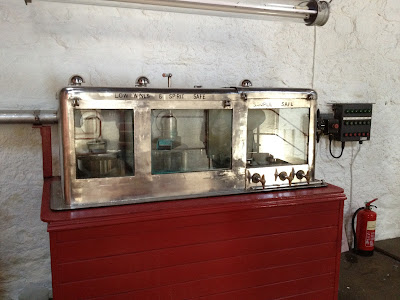 |
| I love the 1950s American diner style of the Glengyle spirit safe |
We popped around the back to see the inspiration for the logo of Glengyle's whisky, Kilkerran. The Glengyle name is currently owned by Loch Lomond and used for one of their blended whiskies, so the distillery can't release its whisky under that name. The steeple of a local church is within sight of the distillery and the peak is framed by a small hole in their wall.
From the distillery we walked back down Longrow to the Cadenhead's shop. We trooped into the back to taste a number of different whiskies from Springbank and Glengyle. Standouts included the Kilkerran WIP5 Sherry Cask (the Bourbon Cask was somewhat unremarkable) and Longrow Red. We also tried some of the Cadenhead's living casks, which are casks that are regularly topped up with their respective whiskies whenever they drop below half full or so. This means that almost every time you go back they will taste different as new whisky is added to top them off.
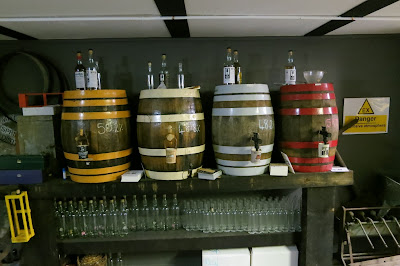
There was also a locked cage containing Cadenhead's 'Duty Paid' samples, which are single bottles from casks that will never be bottled on their own again. This includes fairly standard casks as well as weird one offs like Demerara rum. The upside/downside of this is that there is no way to know what the bottle will be like - no one else has ever tasted it before. Still, it took a supreme act of will not to buy something out of there, but the knowledge that I was at the beginning of my trip and would have to carry anything I purchased around for the rest of my time in Scotland helped. I settled for 200 mL bottles from the Hazelburn living cask and the Campbeltown cask, which is a blend of Hazelburn, Springbank, and Longrow.
 |
| A case of wonders |
After departing Cadenhead's, I walked around the bay to Glen Scotia, in hopes of getting a tour. Sadly by the time I got there, the one employee who had been present that day had just left after giving a small group of people a tour. So it goes - Glen Scotia is a working distillery, I was there on a Saturday, and they don't have an organized system for giving tours. I was really disappointed after
trying their whiskies earlier this year, but it was a sunny day and I had a full afternoon, so I headed back into town to grab some lunch.
 |
| The closest I got to the distillery |
After refueling, I decided to go for a walk around Crosshill Loch, roughly following
this route. I took a slightly more circuitous course through town, but eventually managed to find the path towards the loch, which skirted a number of farms. I walked around the west end of the loch, then headed east and back down towards the bay along the Kilkerran Burn. I ended up at a large cemetery and eventually found the road, which took me north and back into town. It would have been nice to properly hike up Beinn Guilean, but I knew I had an early day coming up and would be working plenty hard to get myself to Islay.
 |
| Looking back into town - the church spire is just visible in the middle |
 |
| Looking south towards Beinn Guilean |
 |
| Crosshill Loch from the west end |
 |
| Looking out across the bay towards Davaar Island |
 |
| The east end of the Loch |
After getting back, I more or less crashed, beyond getting dinner. I knew I needed to get up before 6 AM, so I could finish packing, eat breakfast, then get on the road towards Kennacraig. It was going to be a long haul.


 Archives Fourth Release Glen Scotia 20 Year 1992/2012 Cask 08/71


