Showing posts with label Portland. Show all posts

Thursday, March 12, 2020

Negroni Social 2019

For the last five years I've been getting annual invites to Portland's Negroni Social. As someone on the more socially awkward end of the scale, at least when it comes to strangers, I've previously given it a pass. But since my partner was interesting in going last year, I decided to take the plunge.

2019 marks the centennial anniversary of the date when the Negroni is claimed to have been invented by the eponymous Count who wanted something stiffer than an Americano. Unsurprisingly Campari was very interested in making sure everyone marked the occasion to open their annual Negroni Week charity event.

The location was on Portland's inner east side, a still industrial neighborhood that folks may recognize as the home of New Deal distillery.While the space was excellent and had some nice leftover industrial equipment for atmosphere (see: right), I will admit that it felt a little off to be attending an industry party set up like a major awards show with a red carpet and photographer knowing the number of folks sleeping rough within a few hundred meters. Yes, it was for charity, but that didn't especially ease my discomfort.

With that said, the drinks were almost universally excellent. Everyone attending started off with an amphora-aged Negroni. Yes, they made up large batches of negronis, put them in clay vessels, and then buried them in the ground for two months. Because why not? While good, they were somewhat unremarkable in comparison to everything else on offer.

Rule of Three from Sarah Briggs (1 oz Campari, 1 oz verjus, 0.5 oz Nardin Acqua di Cedro, 0.25 oz Laird's Straight Apple Brandy, 0.25 oz Piscologia, 3 drops saline) - very floral nose with balanced brandy notes, sip begins sweet/sour with Campari bitterness at the end. Refreshingly tart summer drink.

Pruno Magli from Jessica Braasch (1 oz alderwood smoked Campari, 0.75 oz prune liqueur, 0.75 oz cognac, 0.5 oz dry vermouth) - fairly subdued aroma, most orange peel. Sip begins a little limply, but unfolds waves of dark fruit, smoke, and bitterness. Very suited to its month in the PNW.

Fancy Footwork from Judson Winquist (0.75 oz calvados, 0.75 oz Campari, 0.5 oz Averna, 1 oz strawberry-rhubarb syrup, 1.5 oz tonic) - orange and pepper from the garnishes with a bit of Campari on the nose. Sip begins with strong apple notes, fading into orange notes and complex bitterness with a bit of apple sweetness. Peppery finish. Another refreshing summer sipper.

Thelma Taylor from Kyle Trisler (1 oz Campari, 0.5 oz sloe gin, 0.5 oz gin, 0.75 oz sweet vermouth, 0.5 oz Amaro Abano, 1/4 tsp cocoa powder) - complex bitter nose with some fruitiness from the slow gin. Bittersweet sip with balanced gin and sloe, fades into complex bitterness from the gin, amaro, and cocoa. Moderate weight finish.

It's unsurprising that all of the drinks I tried were so good given that the event was pulling in talent from many of Portland's best cocktail bars. All showed a lot of creativity within the Negroni mold. The one part I hadn't full contended with was just how much alcohol was going to be served. Under the circumstances I feel like it might have been better for them to be making half size or smaller drinks so that guests could sample a good range without getting absolutely blitzed.

Tuesday, June 18, 2019

Gin Review: Townshend's

Townshend's began its life in Portland as a tea company, with several locations scattered around the city. From there they expanded into other tea-based drinks such as kombucha. In an odd twist, the kombucha is what led to the distillery - after a scare in the early-2010s that unpasturized kombucha was over over the 0.5% ABV limit, Townshend's made the rather expensive decision to remove the alcohol by vacuum distillation so that the natural cultures survived. This had the side effect of preserving the volatile flavors, both that emerged from the kombucha and those that were added later to the redistilled spirit. Another interesting wrinkle is that because of the significant amount of acetic acid that comes off the kombucha they have to wash the spirit with baking soda to eliminate most of it.

All of this results in very intensely flavored spirits that have none of the notes that are associated with high temperature distilling. Their gin is made from their green tea kombucha spirit that is infused with more botanicals, redistilled, then bottled at 40%.

Townshend's Gin

Nose: big floral notes (lavender, violet, rose), green tea, juniper almost shoved into the background, some round citrus (lemon, lime, a little orange), a little bubble gum.

Taste: cleanly sweet up front, transition into green tea in the middle that becomes increasingly tannic towards the back where the juniper finally kicks in

Finish: balanced tea, juniper, and floral notes that linger lightly

This is, to put it mildly, not a traditional gin profile. The floral notes dominate, with the tea a little behind, and the juniper coming in third. If you're coming from London dry gins, this is likely to seem very odd, but it's more of an evolution of the New West style pioneered in the early-2000s that toned down the juniper in favor of more approachable botanicals. At the same time, the floral notes are so strong that I would say that it's less initially approachable than some other Portland gins like Aviation. Overall I really like it, but it does require a different approach than what you might be used to.

While I originally bought this thinking that it could fill a role similar to Hendrick's, I've since found that it really has a narrow niche. While latter is gently floral, adding some roundness to the standard gin botanicals, this is a whole flower shop. When I tried to make Negronis with this gin, the result can only be described as tasting purple. And definitely not in a good way. What that means is that it needs some fairly stout companions, preferably with some citrus, to really work in a cocktail. And what stouter companions are there in a gin cocktail than those in a Last Word?

Last Word

0.75 oz gin
0.75 oz lime juice
0.75 oz green Chartreuse
0.75 oz maraschino liqueur

Combine all ingredients, shake with ice for six seconds, then double strain into a chilled cocktail glass.

The nose is dominated by the floral and tea of the gin combined with the herbal notes of the Chartreuse, with some lime and maraschino peeking around the edges. The sip begins with moderate sweetness, quickly balanced by the lime near the middle with some maraschino roundess, fading into a complex array of herbal and floral bitterness that stretches out into the finish.

This is a Last Word for people who really want to lean into the Charteuse. While many favor recipes that amp up the gin, that simply won't work with Townshend's, which becomes unbearably floral in anything greater than equal proportions. It works, but it's the balance of great forces shoving each other into submission. If that's your jam, I highly recommend picking up a bottle. If you're not into floral spirits, this is one that you can safely give a miss.

Monday, November 3, 2014

OLCC Follies

Edit: looks like I was wrong and the mistake was at the level of the supplier

Oregon is a control state, with a twist.

The Oregon Liquor Control Commission (OLCC) buys, distributes, and owns the liquor before it is sold. The retail stores are, however, private businesses. The OLCC sets prices and each part of the system takes a predefined cut.

As part of this system, price changes are posted online roughly a week or two before they are reset at the beginning of each month. For those in the know, it gives a heads up for spirits that will be rising or falling in price, so that it's possible to know whether it's better to buy now or wait until later.

On last month's price change list, Laphroaig 10 Year was listed as going down in price by $29.70, which would make its retail price come November an unreasonably low $20.25. I literally burst out laughing when I saw that line, because I assumed that it must have been a mistake and that it would be corrected before the end of the month.

Much to my surprise on November 1st, the online system indicated that, yes, a $20 bill and some change would buy you an entire bottle of Islay single malt whisky. I let my friends know and figured that everyone who wanted some would be able to snag a few.

But that was not to be. I was far from the only person clued into the radical price change. Nearly every store I or anyone else I know went to had any left on their shelves. After calling around to half a dozen stores on Sunday, only one in Portland had even a single bottle on hand. One store employee told me that someone had been waiting at their door before they opened Saturday morning and then proceeded to clear them out. So some people were clearly being more systematic about it than I was and reaped the rewards.

Scuttlebutt from another store employee is that the OLCC really did just make a mistake, but felt bound to honor the price they had posted. This has resulted in a classic economics outcome: a commodity is briefly under-priced by government fiat, which clears out stock on hand, but it can't be restocked because the retail price is below the wholesale price. Two days into November, the Portland area is basically denuded, and it won't be restocked until December when the price can be reset to a more reasonable point. I have a feeling that in a week or two there will be some confused and angry people who can't buy their usual bottle of whisky and will be told that there won't be any more for a while. That might get some of them to try alternatives like Laphroaig Quarter Cask or Ardbeg 10 Year, but not everyone is likely to be placated by substitutes.

I managed to get my hands on two bottles and think that's more than enough for my own consumption, but it also signals the end of FOAFing opportunities for most. The knowledge has spread far enough that you have to be awfully quick on the draw to take advantages of big price changes occasionally offered by the OLCC.

Saturday, February 16, 2013

Rum Review: House Spirits Rum 2011 Release

House Spirits is a Portland distillery that was established in 2005. Best known for their Aviation gin, they also put out what used to be known as their Apothecary line - small runs of experimental spirits. This has included everything from ouzo, gammel aquavit, malt whiskey, and rum.

This rum was released during the Great American Distiller's Festival in 2011. Made with molasses, the white rum was aged for nine months in ex-Chardonnay wine barrels, then diluted down to 40% ABV for bottling.

House Spirits Rum Batch 29

Nose: toasted oak, peanut butter cookies, graham crackers, molasses, light wine cask influence. After adding a few drops of water the nose becomes drier and a little musty with some buttered toast.

Taste: very smooth, creamed brown sugar up front, mild oak, light esters, and pepper mid-palate and back. After dilution it becomes sweeter, but the molasses notes are lighter, with the wine cask finally becoming present.

Finish: short, creamy spices, bittersweet molasses, light esters, drying.

This rum is a huge improvement on their first versions, which were made with turbinado sugar rather than molasses. There is much more body and depth of flavor. With that said, while this is a significantly better effort, there is still room for improvement. While precise distillation and the wine barrels did a good job of rounding off any rough edges, it doesn't have the kind of complexity I would hope for. If I had my druthers, future efforts would focus on increasing the ester content, either through different yeasts or dunder, in the Jamaican style. That would provide a richer base that could be combined with more active wine casks for something really unique and interesting.

Thursday, December 20, 2012

All About the Barrel Rum Class at Hale Pele

Last Sunday, Blair of B.G. Reynolds (esterwhile Trader Tiki) syrups fame hosted a rum tasting class at his new-ish tiki bar, Hale Pele. The theme was 'All About the Barrel', which gave participants a look at how barrel aging shapes the flavor and character of rum.

Barrel aging began as an accident - barrels happened to be the available method for storing and transporting large quantities of liquids for a good chunk of history. Eventually it was noticed that spirits that had been in barrels for a while were significantly better than the raw spirits straight off the still. Over time aging became more of an intentional action, producing the more refined spirits we know and love today. The class began with a discussion of oak barrels and the characteristics of different varieties (primarily American vs. French limousin) and how those influence the spirits that are aged in them. There was also discussion of barrel characteristics such as size (smaller means higher surface area to volume ratio, so more wood contact), char (to a point, higher char caramelizes more wood sugars and other compounds, making them more readily extractable by the spirit), the environment where they are stored (larger temperature variations cause the volume of the spirit to change, moving it in and out of the wood, which speeds up extraction), and spirit entry proof (higher proof spirits will extract flavors more quickly).

From there we moved on to tasting a number of different spirits. My tasting notes are a bit sketchy, as I was trying to write and keep up with the flow of the class, but I still managed to get quite a bit out of it.


The first rum on deck was J. Wray & Nephew Jamaican rum. This is a real fire-breather at 126-proof, which used to scare me to no small degree. However, my palate has evolved and toughened, so I was surprised by how much more approachable I found it now.

J. Wray & Nephew Overproof Rum

Nose: plastic, foreshots, a little grassy, lots of esters

Taste: sweet fruits, coffee, esters

While still a rough 'n ready rum, J. Wray is a lot more comprehensible to me know that I have a handle both on the flavors of Jamaican rums and the ability to drink high proof spirits without instantly choking. While not something that I would want to sip on a regular basis (the plastic notes are still kind of off-putting), there are some nice elements in the spirit.

Blair pouring straight from the barrel
Then we moved on to samples of J. Wray that Blair had aged for 30 days in a 5 liter Baby Barrel.

J. Wray 30 Days Old

Nose: less plastic, slightly oaky, vanilla

Taste: a little caramel, bitter esters, slightly tannic

While still pretty rough around the edges, a month in a small barrel had definitely reduced some of the more unpleasant characteristics of the spirit while adding pleasant barrel notes of caramel and vanilla.

Next up was samples of J. Wray that had been aged for 60 days in the same barrel.

J. Wray 60 Days Old

Nose: lots of vanilla, plastic is much calmer, flatter, caramel, coffee, mellow esters

Taste: very sweet, more tannic at the back, lighter esters

The barrel was starting to win the battle with the spirit, heavily imposing its mark on a very robust rum. At the same time, the tannic elements of the barrel were starting to become a little bit too strong, suggesting that this was reaching the limits of what could be done without ruining the spirit. This is one of the tricky things about small barrels - extraction proceeds so quickly that even a few days too many can over-oak a spirit, so care must be taken to sample it frequently to find the sweet spot of aging.

Changing things up, we tried Don Q Cristal, a white rum.

Don Q Cristal

Nose: very light, almost non-existant

Taste: light, not much going on

This was basically good vodka, with the barest hint of rum character. However, a little while in a 5 liter barrel that previously held Plantation Barbados rum made for an interesting twist.

Don Q Plantation Barrel Rum

Nose: still light, a little caramel, hollow floral notes, vanilla

Taste: sweet wood, vanilla, cognac

This was much more interesting, both bringing in barrel notes (caramel, vanilla, cognac from the previous occupant) and highlighting the inherent floral notes of the spirit. Also, because this was a reused barrel, aging the Don Q in it didn't add any tannic notes to the rum.

After that we switched tack, trying two different rums from Dos Maderas. First up was their 5+3 rum, which is sourced from Barbados and Guyana, then aged in ex-bourbon barrels for five years in the Caribbean, followed by three years in ex-Palo Cortado (a style similar to amontillado) sherry barrels in Spain.

Dos Maderas 5+3

Nose: vanilla, sherry fruitiness, creamy, light nougat

Taste: creamy, light sherry, nutty, a hint of coffee bitterness

While very tasty, I would have a slightly difficult time identifying this as rum rather than another base spirit. It reminds me a lot of sherry cask finished whiskies like Glenmorangie Lasanta, with the nougat and sherry notes on the nose. So while a pleasant sipper, it just doesn't quite tickle my fancy.

Dos Maderas 5+5

Nose: brandied raisins, bittersweet, baking spices

Taste: very sweet sherry, raisins and raisin skins

This is rum sourced from the same Bajan and Guyanese distillers, which is aged for five years in ex-bourbon barrels in the Caribbean, then shipped to Spain and aged three years in ex-Palo Cortado sherry casks, then two years in ex-PX sherry casks. While it has a certain charm, I felt like the sherry barrels had overwhelmed the rum, even more so than the 5+3.

Given that the company is relatively new, my guess is that they're using first-fill (to use the scotch whisky terminology) ex-sherry barrels for their aging. Second- or third-fill barrels might impart a more nuanced layer on the rum, which could provide a more balanced experience. However, given the plaudits that they have received since coming to market (and the fact that it seems to be sold out almost everywhere), it sounds like they're better off ignoring my desires. The market has spoken.

Last, but not least, we flipped things around by tasting Balvenie Caribbean Cask, a scotch whisky that is aged in ex-bourbon barrels for fourteen years, then finished in ex-rum casks.

Balvenie Carribean Cask

Nose: malt, mild raisins, lots of hogo

Taste: malty, a little pepper, dry rum finish

Sadly I wasn't able to get as much out of this rum as I would have liked, given that it was the last one of the class and my palate was already kind of burned out. The hogo on the nose was rather surprising, but a nice twist on the usual whisky aromas. I'd like to give this one a try again under better circumstances.

I was really pleased with how the class went. Blair had a good theme, structured the class well, and presented a lot of useful information. More classes are planned, so if you're in the Portland area, keep an eye out on the Hale Pele Facebook page or events calendar for news.

Thursday, October 25, 2012

New Cocktails: The McCarthy Project

After my review of the whiskey, I decided that I wanted to try to make a cocktail with it. There aren't too many cocktails that use peated whisky, as it tends to dominate as an ingredient, but there are a few. I used the Laphroaig Project as a template, but tweaked it a bit to account for the fact that McCarthy's Single malt isn't as strong or smokey as Laphroaig Quarter Cask.

The McCarthy Project
0.75 oz Green Chartreuse
0.75 oz McCarthy's Oregon Single Malt
0.5 oz Luxardo Maraschino
0.25 oz Yellow Chartruese
0.75 oz lemon juice
2 dashes Fee's West Indian Orange Bitters

Combine all ingredient, shake with ice for six seconds, then strain into a chilled cocktail glass.

The nose is balanced between sweet grassy notes from the Chartreuses and smoke from the whiskey. The sip opens a bit thin, but proceeds to expand with herbal notes from the Chartreuse, a burst of smoke, then funky cherry notes from the Maraschino. The finish is sweet and sour, with a bit of smoke.

I'm pretty pleased with how this one turned out. Admittedly, as Camper English noted about the Laphroaig Project, "If you have all of these ingredients at home you are a huuuuge cocktail geek."

I resemble that comment.

Tuesday, October 23, 2012

Whiskey Review: McCarthy's Oregon Single Malt

American-made single malt whiskey is still relatively rare, but one distillery has been producing peated whiskey for almost two decades.

I've mentioned Clear Creek Distillery before and it is both a local institution and one of the oldest craft distilleries in the United States. While original established to produce fruit brandies, their product line has expanded over time to include other spirits, including whiskey. They buy peated malt from Port Ellen on the Scottish island of Islay, which is the malt source for well-known distilleries like Ardbeg, Laphroaig, Lagavulin, and Caol Ila. The malt is brewed into unhopped beer by Widmer Brothers Brewing, then distilled and aged at Clear Creek. As far as I can tell, McCarthy's Single Malt is the only malt whiskey that is only distilled once (compared to more traditional double- or triple-distillation), though they are using Holstein stills that contain bubble plates to control the amount of reflux rather than the simple pot stills used to make scotch whisky. They describe their distillation process as "mak[ing] a small “heads” cut and a fairly large “tails” cut and put[ting] about 4 liters of tails into the next still run.". The whiskey comes off the still with an average distillation proof of 150 (75% ABV), which is actually on the low side for single malt whisky. Aging is carried out in casks made from air-dried Oregon oak (Quercus garryana). As I understand it, new make is placed in fresh casks for one year, then moved to refill casks for the next two years. So far all releases have been aged for three years. I have spoken to the McCarthys and they stated that while they would like to age their whiskey for longer, the demand is such that they have a hard time keeping up, even at such a young age. While I can't nail down a precise date for my bottle, the gold foil around the label and the 40% ABV likely place it somewhere between 2006 and 2008.

McCarthy's Oregon Single Malt

Nose: salty barbecue, bacon, peat, tar, slightly feint-y, licorice, dry leaves, a touch of pine, caramel sweetness, vanilla. After dilution, it becomes a bit thinner, with pine-y peat, more salty bacon, and licorice that reminds me of black Magic Markers.

Taste: strong wood sugars, salted licorice, medium spirit heat, mild smokey/vegetal peat at the back, and an overall creamy feel. After adding a few drops of water, the taste becomes pure sucrose up front, with a brief segue to peat, then back to sweetness, with just a hint of oak.

Finish: peat, a bit of sweet oak, light fruit

This whiskey is an interesting contrast with the bottle of Kilchoman Machir Bay I reviewed recently. They're both roughly three years old (though the Machir Bay has some older whisky in the mix) and peated. McCarthy's makes me a think of a mash-up between Islay whisky and American bourbon, with the mix of peat flavors overlaid on a lot of woody caramel sweetness. Kilchoman is almost the essence of Islay.

Out of curiosity, I tried watering down the Kilchoman to 40% to see how it compared. First off, it reinforces my belief that whiskies are blended together to work at a particular ABV. Machir Bay retains most of its flavors, but the mouthfeel and flavor density definitely suffer, even after a few days of integration. Interestingly, most of the peat disappears from the nose. It's mostly malty, with just a hint of smoky peat, licorice, and berries. The palate is unfortunately rather watery at first, but gains steam mid-palate, with most of the same flavors that I found at full strength, but it slumps again in the finish.

In contrast to the Kilchoman, McCarthy's peat is much more about salted meat than ash and smoke. I also think it works fairly well at 40%. I wouldn't mind giving it a try at 43% or even 46%, but it doesn't seem watery, especially on the nose, which has great density. I also believe that the ABV of newer bottlings has been raised a few points, which should help it out. The bottom line is that if you enjoy Islay whiskies, I think you will be pleasantly surprised by just how good an American homage to the style can be. Prices can be a little steep, with a recent rise to $55 in Oregon, but much like Kilchoman, I think it's well worth the investment.

Thursday, August 30, 2012

Hale Pele: Portland's Newest Tiki Bar

Earlier this year I was extremely disappointed to hear that one of my favorite watering holes, the tiki bar Thatch, was closing. However, I was quickly soothed when I learned that the space was being taken over by Blair Reynolds of Trader Tiki/B.G. Reynolds syrups fame. If anyone knows tiki, it's Blair, so I trusted him to do it up right.

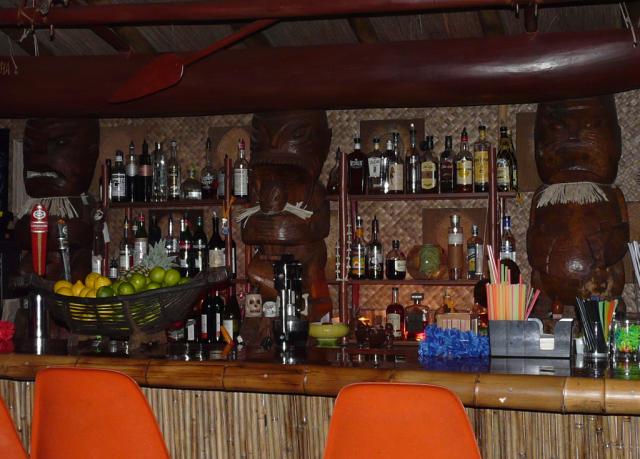
Last night was the opening night for Hale Pele, as it has been rechristened. Blair has kept everything done right by the former owners and added some nice new touches to the place. The ambiance is perfect, with the tiny bridge over a water feature ushering you into a tiki wonderland.


The water feature abides

The main bar, overseen by the the three Marquesan Baby Eaters from the original Portland Kon-Tiki
Blair chats with customers

The tiki gods confab at the end of the bar

I got to the bar about an hour after the doors opened and it was already packed to capacity. The space is relatively small, with about a dozen seats at the bar and maybe two or three times that many in booths along the opposite wall. The size seems to be about right, as more seating would definitely strain the abilities of the two bartenders behind the stick to keep up with orders.

As a nice cameo, Martin Cate of Smuggler's Cove and tiki guru extraordinaire was there to help with the opening.

Thankfully I was able to nab a seat in a booth quickly after arriving. I settled in and glanced over the well balanced menu to see what was available.


After a bit of thought, I ordered a mai tai (the true test of a tiki bar). While it took a little while to get my drink (they were swamped), it was worth the wait. Blair has gone for the most serious Mai Tai possible, a 1:1 split of Smith & Cross Jamaican Navy proof rum and St. James Royale Ambre rhum agricole. This is a very rum-forward mai tai and a force to be reckoned with. It actually reminded me a lot of my personal mai tai recipe, though even more amped up.


While I only sampled a few of Blair's wares, looking over the back bar made me almost start drooling with the vast selection of rums and other spirits. There are some real gems on the top shelf, like Rhum J.M. VSOP and 1997, as well as a bottle of Clément XO that I really want to try.


The rum selection is... voluminous...
The people working behind the bar and the waitstaff did an excellent job given how full the bar was. Nathan and Mindy (I think that's her name) were putting out fantastic drinks along with Heather playing a bar-back roll (I think?). One sign of quality is that everything was being measured with Oxo measuring cups, meaning that the drinks were perfectly balanced and should remain so every time you order one.

Mindy rocks a serious Hawaiian shirt

Nathan in action
After the mai tai, I relocated to the bar and ordered a Jet Pilot. It showed up in 'reentry' fashion with a flaming sugar cube and a dash of cinnamon to give it real pyrotechnics. The drink was easily as good as the one I got at PKNY a few years back and half the price. It had a really excellent balance, with the strong flavors of Lemon Hart 151 just edging out the sweet, spice, and sour elements of the drink. They also have their blender technique down proper, as the drink started out strong to remind you just how much rum is in it, while retaining solid flavor as it was diluted by all of the crushed ice.


I finally departed after several enjoyable hours and rode home in the cool of the evening. I look forward to many more trips to Hale Pele and seeing how the bar evolves over the coming years. If you're looking for an enjoyable place to get a drink in Portland, I would put Hale Pele right up the with the other mixology heavyweights of our fine city.

Sunday, May 27, 2012

Cocktail Camp PDX, Part II

Now for Part II in my set of posts about Cocktail Camp PDX.

The Lunchtime Social Hour was run by New Deal Distillery. There were a handful of cocktails being made, but I only got a chance to try one:

Ginger Fizzle
1 oz New Deal Ginger Liqueur
0.75 oz rye whiskey
0.75 oz lemon juice
1 oz dry sparkling wine

Combine all ingredients except for the wine, shake with ice, then strain into a chilled glass and top with the sparkling wine and a dash of Angostura bitters.

The nose presented the sparkling wine, a hint of rye, the spice of the bitters and a bit of vegetal ginger. The sip opened with bitters, sour lemon and ginger, the sparkling wine coming in mid-palate, finishing with the ginger bite, with a fruity note that reminded me of pineapple weaving through it all. Overall a decent drink, but it just didn't quite come together for me. Which is a shame, because I like the set of ingredients, but I might have to tweak the proportions to make something that will fit my tastes.


The first talk of the afternoon was the Perfect Host, presented by Morgan Schick of Jupiter Olympus, a cocktail consulting and events company. This was designed to give people a sense of how to put together a cocktail party and build a menu with sufficient breadth to keep people interested, but not so broad that it's impossible to have every single ingredient on hand. One way to deal with this is to stick to the basics - drinks like Manhattans, Gimlets, Martinis and the like can all be made with a handful of ingredients, many of which will pull double- or triple-duty, allowing you to make a decent number of drinks without a huge back bar. Additionally, by introducing only a few other elements - homemade syrups, some simple infusions - you can generate new and interesting twists on those drinks without greatly expanding the number of necessary ingredients.

A Manhattan variation, the 17,000 (the number of islands in Indonesia, where Batavia arrack comes from), was served during the Perfect Host talk:

2 oz bourbon
1 bar spoon Batavia arrack
1 oz sweet vermouth

Combine all ingredients, stir with ice and strain into a glass

Sadly this one just didn't do much for me. Admittedly, that's largely due to the fact that Manhattan-style drinks just seem too bitter, but I felt like the arrack wasn't balancing well with the other ingredients. I'm tempted to play around with it on my own, but it seems like a tricky one to get right.


The Afternoon Social Hour was sponsored by Campari, which meant that all of the cocktails a) contained Campari and b) were designed to be aperitifs. The first one I tried was a relatively spicy number by David Shenaut:

The Souracher
0.75 oz 100-proof rye whiskey
0.75 oz Campari
0.75 oz Cocchi Vermouth di Torino
0.75 oz lime juice

Combine all ingredients, shake with ice, strain into an ice-filled Collins glass and top with ginger beer.

This one just didn't quite tickle my fancy. Mostly ginger and vermouth on the nose. The taste led off with some sweetness from the ginger beer, creamy lime mid-palate, and finished with bitterness from the vermouth and Campari mixed with the grainy spice of the rye. The flavors felt a bit muddled, though they integrated a bit better after some of the ice had melted. As with the Ginger Fizzle, I felt like there was a good drink inside it, but it needs some tweaking to really fit my tastes.

After the Souracher, I sipped a drink from Allison Webber that rescued an otherwise somewhat lackluster set of cocktails:

Belle Époque
1 oz Campari
1 oz Spanish brandy
0.5 oz Palo Cortado sherry
0.5 oz Dolin Blanc vermouth

Combine all ingredients, stir with ice and strain into a chilled glass.

This was a seriously good drink. The nose was sweet and spicy, with big fruit and vanilla - overall a fantastic sweet/savory balance. The sip was a reprise of the smells, in the same order, with a bitter, slightly salty finish. Given how heavy it was on bitter aperitif-oriented spirits, it came together with shockingly good balance. Every element had its place, presenting itself and then making way for the next piece. My mouth waters just to think about having another one of these cocktails.


The last talk of the day was an Introduction to Aperitifs, presented by Neil Kopplin of Imbue Vermouth and Tony Devencenzi of Bourbon & Branch. The talk began with a small history of aperitifs. Their historical antecedents go back to the medicinal tinctures that had been created since time immemorial from herbs and spices steeped in alcoholic beverages. Their definite beginning came with the invention of vermouth in 1786 by the Italian merchant Antonio Benedetto Carpano. Carpano soaked a mixtures of herbs and spices in white wine, then dyed it a deep red. This was what would come to be known as sweet or Italian vermouth. The drink became popular and a few decades later, at the beginning of the 19th century, the Frenchman Joseph Noilly created a pale, drier variety of vermouth that we know now as dry or French vermouth.

Another class of aperitifs are known as quinquinas, originating with Joseph Dubonnet in 1846. Dubonnet's drink was developed as a delivery method for the malaria-fighting bark of the South American chinchona tree, which contains quinine. These aperitifs have a particular quality of bitterness that it different than that found in vermouths. Other bitter aperitifs emerged over time, such as Campari, Aperol and amari bitter liqueurs like fernet, Cynar or Jägermeister.

What all of these drinks have in common is a bitterness that makes them good to drink before a meal. This is because the brain associates bitter flavors with poison, which stimulates the salivary glands in an attempt to dilute the ingested compounds. In the case of aperitifs, this helps to prepare the mouth for the meal to come. Additionally, aperitifs usually have a fairly low proof around 20-30% ABV. This makes them relatively light on their own and even more so when lengthened with soda water or other non-alcoholic drinks. As Neil put it, this makes them 'sessionable' as you can spend time drinking them without becoming significantly intoxicated.

Neil talked a bit about the creation of his own aperitif, Imbue bittersweet vermouth. This is another one of those Oregon products that came about because people were sitting around drinking and decided that they wanted to make something new and interesting with all of the great materials that this state has to provide. After a lot of experimentation, they came up with a vermouth that is somewhere in between a sweeter traditional blanc vermouth and dry vermouth, which is more bitter. I got to try some mixed with ginger beer and a dash of Angostura bitter. The results were pretty tasty. I'll be picking up a bottle once I've gotten through my current bottle of sweet vermouth.


Overall I really enjoyed Cocktail Camp. I got to learn a lot and drink some very tasty drinks. I'm looking forward to seeing what the event looks like next year.

Saturday, May 19, 2012

Second Anniversary - Another Year of Booze Blogging

As per last year and in keeping with traditions, it seemed like a good time to reflect back on the previous year of blogging.

•I'm still really enjoying blogging, though there times when it feels like I've let its demands get ahold of me too much. It's funny, but I just don't drink fast enough or often enough. However, the liver transplant surgeons of the world would probably disagree with that assessment.
•It's amazing what a regular posting schedule has done for my traffic. It took about a year and a half to get my first 10,000 page views, but only four months to get the next 10,000. My one New Year's resolution was to post twice a week and I've pretty much stuck to that. And tried to make up for it when I've slipped. Hopefully I get can get to three times a week or more at some point, but there is that small matter of the rest of my life in the way. Time will tell.
•It's been very interesting dipping my toe into the world of whisk(e)y. From those first few tentative steps through rye and bourbon, I've since come to love grain-based spirits from across the globe. It's pushed me to think a lot more about the details of the spirits I drink, both on their own and in cocktails. However, it's also kind of an expensive hobby.
•On that note, it's been interesting to note the relative output of the cocktail and whisk(e)y blogospheres, as it feels like the former has been ebbing a bit while the latter picks up more and more steam. Admittedly there's a little confirmation bias there because I've been searching out new whisk(e)y blogs, which means they're more likely to be active, but the updates on the sidebar have definitely taken on a new pattern.
•With that said, tiki continues unabated (thanks, Doug). Sometimes with a vengeance.
•I've really enjoyed sinking my teeth into the world of rhum agricole. After a rough start, we are definitely good friends now.
•Still not much of a garnisher, but I'll dabble from time to time. Getting a channel knife for Christmas helped.
•Still enjoying making my own ingredients and looking forward to covering more of them in the future.
•Still thankful to the Horde for all the traffic and the booze conversation that comes my way via the OTAN.
•While there are some really excellent distilleries in the area, as I noted last year, some of the newer entrants are incredibly disappointing. I'm hoping they'll step up their game, but they're in a tricky position.
•I've found some great new places to get a drink and should be reviewing a few more soon.

Once again, thanks to everyone who's read my blog over the last year and here's to many more to come.

Monday, December 5, 2011

Happy Repeal Day!


Once again it's time to celebrate Repeal Day, as December 5th marks the end of Prohibition and the return of sweet, sweet liquor to America.

Prohibition represented a dark day in American history, when we collectively decided that people shouldn't be able to make their own decisions about what to consume and went so far as to put it into the Constitution. Now admittedly, as I've mentioned before, America was an awfully hard-drinking nation back in the 19th century. The attendant problems of alcohol consumption drove many Progressives to advocate for temperance as there was a wide-spread belief that alcohol was at the root of many societal ills and that sobriety would lead to a veritable utopia. Some worked through social pressure, others by force of law.

Obviously we all know how well that worked out. There's strong evidence that alcohol consumption increased during Prohibition compared to before enactment of the law. Crime increased as the mob gained power, money and influence. Respect for the law decreased, both because of the manifest absurdity of Prohibition and the woeful ineffectiveness of local, state and federal enforcement.

It took the Depression and the desire for new tax revenues to finally turn the tide and Prohibition was officially repealed on December 5th, 1933 when Utah (who'd a thunk it?) ratified the 21st Amendment, crossing the three quarters threshold needed to enact the statute.

So raise a glass to celebrate a small return to sanity and personal responsibility. I'm currently enjoying a glass of rum distilled here in the good ol' U.S. of A.

Many thanks to Jeffery Morganthaler, who created the Repeal Day holiday. If you like, you can personally thank him by dropping by Clyde Common where he currently manages the bar.

Wednesday, October 26, 2011

Spirits Tasting at OMSI After Dark

The Oregon Museum of Science & Industry here in Portland hosts regular events where adults can come to the museum after hours and enjoy drinks while getting to act like kids. There is usually some kind of theme to the evening and this month they dovetailed with Portland Cocktail Week and the Great American Distillers Festival to provide another opportunity to taste spirits from local distillers. As there were both a number of spirits that I didn't get to try at the GADF represented at this event as well as others that weren't present on Sunday, I decided to go, this time with more food in my belly. Once again, here are some small impressions from what I tried. However it was still hard to get much depth given that I was drinking out of a shot glass most of the time.

Blair Reynolds, the former Trader Tiki, is a fine gentleman. His white dog hot toddy was a little peculiar, but an interesting drink. I also really liked the hazelnut orgeat and will probably pick up a bottle to give my mai tais a twist.

•I finally got to try Clear Creek's 8-Year Old Apple Brandy. It's an interesting contrast to the 2-Year Old version. Whereas the younger brandy is bursting with apple flavor, its older sibling has been significantly tamed by the extra time in the barrel. It's a little less identifiable as an apple brandy, edging towards a nice cognac with a more diffuse fruitiness. While it's a little thin at first, a drop of water opens it up nicely. The taste is berries with a hints of vanilla and wine, balanced by mild oakiness. I'm definitely going to spring for a small bottle of this brandy so I can do a more in-depth review.

Big Bottom Port Cask Finish Whiskey is excellent stuff. Much like the Angel's Envy whiskey I tried on Sunday, the bourbon for this whiskey is sourced from another distiller and then finished in used port casks. I chatted for a bit with Ted Pappas, the founder of Big Bottom, and he mentioned that this whiskey is sourced from Indiana. While Ted would "neither confirm nor deny" his source, the mash bill matches perfectly with the high rye juice from the notoriously guarded Lawrenceburg Distillers Indiana (LDI). While this is a younger 3-year old whiskey compared to AE's five and six-year old base, it tasted mature beyond its years. The choice of tawny rather than ruby port seems more well suited to bourbon and the two meshed quite well. There was a solid bourbon base of corn, grain, vanilla and a healthy dose of rye spiciness up front. This was followed by the rich flavors of tawny port nearer the finish. The residue of this whiskey was very more-ish and I'm definitely going to buy a bottle.

The Meadow is a store in Portland that sells speciality ingredients like salt, chocolate and bitters. They had quite a spread at this event. Not only were there several dozen commercial bitters, but they also put out nearly as many tinctures that people could use to create their own bitters. I took a whiff of a number of different bitters. The Bitterman's Xocolatl Mole bitters and Elemakule Tiki bitters were probably my favorites, but Elmegirab Aphrodite bitters were also quite intriguing. I need to start playing around with bitters again because they're a relatively cheap way to add more variety to drinks.

•I made the mistake of giving Oregon Spirits another chance. They're releasing a genever-style gin and that was abundantly clear from the first sip. It's full of the peculiar roasted pineapple flavor that I've noticed in other genevers. Unfortunately there really wasn't much else going on and I couldn't even find any juniper among the malt flavors. I'm going to give them a miss for a while until they have some more experience under their belts.

•Thankfully the Rogue Pink Spruce Gin was much better. I'd tried it before, but wasn't much for straight spirits at that point. This time I really liked the gin. There was a solid base of juniper and spruce pine flavor. This was complimented by a very whiskey-ish layer of sweet vanilla, candied fruit and cinnamon spice. This would make a great Old Tom substitution or is perfectly pleasant for sipping neat. Another one that's getting added to my 'to buy' list.

Overall it was a really nice event. I was glad that I showed up not too long after opening because it got much more crowded as the evening went on. However, I got to try everything I wanted to sample and usually didn't have to wait too long. The complimentary shot glasses and hot water to wash them out was a nice touch and probably cut down a lot on the waste the event produced. Finding a few new products that I liked enough to buy was icing on the cake.

Tuesday, October 25, 2011

The Great American Distillers Festival; or Why It's Tough Being New

While I wasn't able to attend any of the other events during Portland Cocktail week, I did make it to the second day of the Great American Distillers Festival on Sunday. Held in a small-ish event hall, there was still quite a lot of booze spread before me when I entered.

A slice of the available booths

Unfortunately my stomach was a little too empty to make it to every booth, but I did get to try a number of interesting products. My thoughts were a little sparse and became more so as I was plied with whisk(e)y, but here's what struck me at the time.

12 Bridges Gin keeps getting better. Their latest release has dialed back the cucumber notes that used to dominate the gin and become very pleasantly floral. It was also good to hear that their distribution issues are local, rather than being a supply issue.

Cyrus Noble whiskey is totally decent. This private label bottling of Kentucky bourbon has some corn sweetness and vanilla without any noticeable harshness. Probably worth another try when I can have more than a fraction of an ounce, but it's pretty obvious that this bourbon doesn't have more than five years under its belt. Value will be highly dependent on the price-point.

Dry Fly Washington Wheat Whiskey is also totally decent. I found it to be quite gentle for only two years in the barrel. The flavor was grainy, without bourbon's corn sweetness or vanilla due to the pure wheat mash bill. The fact that it's an agricultural product was still clear given that the barrel hasn't had time to dominate. Again, probably worth another try, but it didn't jump out at me with complexity. However, I also felt the same way about Berheim's wheated whiskey, so it may just be that the category isn't for me.

Chatoe Rogue is a new-ish single malt whiskey from Oregon. If I understood correctly, it's aged briefly for 3 months in used chardonnay barrels. This whiskey tastes very fresh, which is unsurprising given how close it is to being a white dog. While there isn't a whole lot of complexity yet, it's still pretty decent for its age and might work well in a New Orleans sour with some orange liqueur and lime juice to round out the flavors. But at the price point, it's kind of a tough sell.

•I tried a number of Golden Distillery's products. Their single malt whiskey had a surprising dose of vanilla in it, which comes from being aged in white oak 10 gallon, rather than standard 53 gallon, barrels. It was another good, relatively fresh product that should improve nicely with more age. I also tried their Reserve whiskey, which is also aged in red oak barrels. It was hard for me to suss out any extra flavors, but my palette was getting a bit burned out at that point. Their apple brandy unfortunately seemed kind of thin and fient-y without the kind of rich apple flavor that I expect. On that front, I think I'll stick with Clear Creek.

•Just to prove that it wasn't just the little guys, I also tried the 12- and 18-year old bottlings from Jameson. In all honesty, they really did nothing for me. Again, my taste buds may have just been too abused to catch the subtleties, but I didn't even finish the sample of the 18-year that I was offered. C'est la vie, I guess.

•Oregon Spirits' wheated whiskey was also a bit simple for my taste, but it might get more interesting with age.

Angel's Envy whiskey was another private bottling, rather than a local product like so much of what was at the Festival. This is a five to six year old bourbon that is then additionally aged for 3 to six months in port casks. This was the last whiskey I tried while I was there, so it was nearly impossible for me to pick up on much. While I'd need to try it again to be sure, I felt like this was another case where I felt like it needed a lot more age. With some 10+ year old stocks and another 6-12 months in the port casks, this could be really good. But it's hard to justify shelling out $50 for something so young that isn't even coming from a craft distillery, even if it has been reviewed very, very favorably.

•Some of the big boys were there to play as well. Four Roses put out quite a nice spread of spirits. While I had previously tried their Small Batch bottling and found it less than appealing, their Single Barrel (Warehouse 5, Barrel 3-6U) was quite a bit better. It had a fairly light nose with hints of brown sugar, vanilla, yeast and caramel. The taste recapitulated the smells and had only a slight burn. I also got to try some of one of their Limited Edition bottlings (sorry, I forgot to write down the details of what all went into it), which was at least as good if not better than the Single Barrel. They're both on my 'to try again' list and it sounds like the price of the Small Batch and Single Barrel should both be coming down in the near future.


So overall, the unfortunate impression that I came away with is that most craft whiskies are just too young right now. I'm not the first to come to that conclusion. Right now they're in a really tough place. I think a lot of people have gotten into distilling because they want to make whiskey, but unfortunately that's as much or more dependent on time in the barrel than it is on what comes off the still. And that's expensive. Aging ties up both space and capital, neither of which are likely to be plentiful for a company that's just starting out and wants to become profitable sooner rather than later. This can lead to a number of different traps, all of which are tricky to get out of.

To begin with, just about every distillery out there makes vodka and gin. This isn't surprising, because they're comparatively easy to make and require no aging. This can start a decent revenue stream. But if the dream is ultimately to make aged products, it's hard to build enough capacity to both keep up with the demand for your unaged products and to distill the stuff that you want to put down for a while. Sure, you can always buy another still, but that costs money, which usually isn't exactly plentiful for new distilleries.

Another route that many distilleries are taking is to bottle whiskey bought from one of the big distilleries. It's not uncommon that they have barrels sitting around that don't quite fit into their established products but are on their own still worth drinking. This is a totally reasonable idea, but has its own complications. It's early days, so we'll see how and whether people are able to transition over to their own aged whiskies, but it's going to be a tough switch.

Lastly, and most popularly, distilleries release whiskies that haven't had a lot of time in barrels. As I mentioned above, some people try to speed this along by using smaller barrels, but it's debatable how much that helps. Some of the reactions that produce the flavorful compounds in whiskey take time to develop and there's no way to speed up the process. Especially with single malt whiskies, time in the barrel seems to be particularly important as they're starting with a single grain rather than the mixtures used for bourbon. I think there's a good reason why scotch usually starts to get really good around 10-12 years. Again, as I mentioned above, there are a lot of whiskies coming to the market with a few months to a few years under their belts. Sometimes that works. I've tried a few 4-5 year old whiskies from microdistilleries that were quite tasty. Even less can still sometimes produce a great product. But you have to accept them for what they are, rather than expecting the rich, vanilla and sweetness-laden whiskey that most bourbon drinkers know and love. And when you consider the price differential between most craft-distilled whiskies and those made by bigger producers, it can get tough to justify shelling out that much cash. I feel like in a lot of cases people (myself included) are willing to pay a premium for what they see as potential, rather than because what's being current put out is the best thing ever. Craft distilleries have to work with what they have, whereas big distilleries have decades of stock to blend into consistent products. So there are hits and misses. Unfortunately it's going to be tough to bring in a wider audience that is accustomed to consistency.

While I feel like I've been a bit doom and gloom, I don't think that all is lost. It's early days and craft distilleries that have been around for a while are putting out really excellent products. However, there does seem to be no small amount of hype and I'd hate for some good projects to be nipped in the bud because they can't deliver right now. In another 5-10 years, I expect to be drinking a lot more really excellent craft whiskey. But right now I'm hoping that there's a lot of what I drank this last weekend sitting in barrels, waiting to see the light of day some time in the slightly distant future.

Sunday, October 17, 2010

Drinking in PDX

As a follow-up to my piece about good places to drink in NYC, I thought I'd bring things a bit closer to home.

Portland, while far from the biggest city on earth, has a lot going for it in terms of being able to get a good drink. The OLCC may be a pain in the rear, but we more than make up for it with lot of local producers of beer, wine and spirits, coupled with a burgeoning mixological movement. Since they're usually the drinks I'm willing to go out of my way to get, this is however going to be a bit tiki-heavy.

Thatch Tiki Bar

Thatch is a fairly recent addition to the Portland bar scene and provides some competition for Portland's other tiki bar, The Alibi. Thatch does have a fair amount of history to it, as much of its decor was rescued from Jasmine Tree, a former Portland tiki staple, which had obtained its decor from the former Kon-Tiki of Portland. Tiki never dies, it just gets passed down the generations. So the atmosphere of the bar is absolutely perfect, from the little bridge over a water feature that you cross when entering the bar to the pufferfish lanterns to the (in)famous Marquesan Baby Eaters. However, what really matters are the drinks. I first went to Thatch for my birthday earlier this year and make the mistake/entirely correct choice to get a 1934 Zombie. It's not a drink for the faint-hearted, as the total alcohol content is equivalent to about 6 oz of 80-proof spirit or roughly four regular drinks. They're usually listed as a "limit two per customer" drink and one was more than enough for me. Both my roommate and I ended up sitting around the bar for another couple of hours just downing water in an effort to sober up so we could get ourselves home. During our next visit, we were able to get there for happy hour, so the $5 mai-tais were more or less mandatory. Mine was totally decent, though I'm a bit happier with some of the ones I've made at home. The Nui-nui I had was also totally decent, though it was a little weak in the rum department, mostly tasting like orange juice and cinnamon. Tasty enough, but since I tend to like rum-forward drinks, this one felt lacking. With that said, my own attempts at the Nui-nui have left something to be desired, so I can't really fault them. I seems like a tricky drink to get right, even though all of the ingredients seem dead on. Some day...

But to wrap things up, Thatch is definitely a place to visit, even if you've never had a tiki drink or have been unfortunate enough to only be exposed to low quality versions so far. They have an excellent selection of rum and other spirits and seem to take a lot of pride in making solid drinks.

Teardrop Lounge

While the Teardrop has a reputation for making solid cocktails all the time, it was the siren song of tiki drinks that drew me in. Due to a relationship with Trader Tiki, the Teardrop has tiki nights from time to time.


My first drink, as pictured to the right, was the Lift-Off! In case it wasn't clear, about thirty seconds before I took that picture the spent lime shell was full of flaming 151-proof rum, which made for a pretty excellent show. The drink itself was a little bit less exciting, with the rum fading into the background more than I would have liked. Still tasty, but it didn't knock my socks off. Thankfully the night was more than saved when I took a bit of a risk and ordered a Donga Punch. I say that it was a risk, not because I didn't trust the bartender, but because I'd had less than wonderful experiences with rhum agricole before. I had previously bought a bottle of St. James Royale Ambre for making mai-tais. However, it proved to be a less than stellar choice as it has an incredibly strong, incredibly funky and generally off-putting flavor. Further experimentation showed that it could be useful, but only in small doses and balanced by other rums. However, the Donga Punch is a one-rum drink, so I wasn't sure exactly what I was in for. But as I've already noted, it turned out beautifully. The sourness of the lime and grapefruit was perfectly balanced with subtle funkiness from the rhum and the spice of the cinnamon syrup. I was absolutely entranced and took a quick peek behind the bar before I left to find out what kind of rhum had gone into making the Punch. While it took a bit of tracking down, the ever-useful Pearl Speciality Spirits came to my rescue so I could pick up a bottle of Rhum J.M. Gold. Ever since I've been happy whipping up Donga Punches, which are now hands down my favorite drink.

While there are many other Portland drinking institutions that I need to sample and write about, these two are a solid start for anyone looking for a tasty libation in town.

Wednesday, October 13, 2010

Local Flavor, Pt. II: House Spirits

Up next in the series, I'd like to return to the topic that featured prominently in my very first post, House Spirits.


My introduction to their products goes even further back. Back around 2005 I discovered that gin was in fact rather tasty. While poking around the local liquor store, intent on getting a bottle of Bombay Sapphire, I noticed another bottle of gin on the shelf that said it was made in Portland. Since I tend to like buying local products and it didn't cost a whole lot more, I took a risk and got a bottle. That turned out to be a very good choice as Aviation suited my tastes even better than the Sapphire. To explain some of the differences, I'll have to go a bit into the history of gin. These days, people tend to associate gin almost exclusively with the London Dry style (Tanqueray, Beefeater, etc.), but that's only a fraction of what was and lately has lately become available.


The diagram above shows the relationships between different styles of gin and their general characteristics. Bombay is firmly in the London Dry style, which means that it has a very sharp and juniper-heavy flavor profile, due to the fact that the botanicals are extracted by placing them in baskets within the still so that the hot alcohol vapor passes through them and carries some of the flavor along. In contrast, a gin like Aviation, which is modeled after Dutch genever, is produced by soaking the botanicals in neutral grain spirits and then distilling the resulting 'tea'. This results in a much rounder flavor profile.  Aviation is also less dominated by juniper and has a lot of citrus flavor. Overall it still has some of that distinct gin bite, but it's less astringent than a juniper-forward gin. Which is all to say that it's rather tasty to me.

Bring us back to the topic at hand, while my tastes have shifted away from gin since then, I've still been watching House Spirits closely as their product line has grown a lot since I first discovered them. Though they started off doing exclusively unaged, white spirits (vodka, gin and aquavit), they are now producing a much wider variety of spirts, ranging from whiskey (both aged and unaged) to shochu (distilled sake) to rum (unfortunately not very tasty, from my perspective) and more. In addition, their on site store has expanded dramatically in the last few months to include all sorts of cocktail equipment, ingredients and books. House Spirits is a wonderful local icon and I look forward to seeing and sampling the new spirits that they're going to be putting out over the coming years.

Tuesday, September 14, 2010

Local Flavor, Pt. I: Clear Creek Distillery

As some of you may know, Portland has been at the forefront of the craft distilling movement. They tend to take cues from the craft brewing movement of the last few decades, emphasizing quality and sourcing local ingredients.

One of the oldest craft distilleries in Oregon, perhaps in the country, is Clear Creek Distillery. A few years back I was fortunate enough to take a tour of their facilities in NW Portland. Back in their cavernous warehouse space are a row of gleaming copper stills, surrounded by their fermenting tanks, bottling lines and other sundry items. Further back is a room devoted to their aging spirits, which literally has a heady atmosphere from the "angel's share" of evaporating alcohol.

I recently purchased a bottle of Clear Creek's 2 year-old apple brandy. The work and dedication to quality that Clear Creek is known for are abundantly clear. The brandy smells exactly like where is came from, dry hard apple cider made from high-quality local ingredients. The alcohol smell is surprisingly subdued for something that was only aged two years, but it's young age also means that the apple flavor hasn't been lost amid oak.


The obvious choice for a cocktail was the Sidecar:

1.5 oz apple brandy
0.25 oz orange-tangerine-kumquat liqueur
0.75 oz lemon juice
0.4 oz simple syrup

Combine all ingredients, shake with ice and strain into a chilled glass.

The apple brandy played exceptionally well with the sweetness of the liqueur and was nicely balanced by the tartness of the lemon juice. The liqueur also has just enough spice flavor to fit with the impending change in season. This is definitely a drink I'd like to have again when the weather cools down.

This should be the first in a series of posts I'm planning to write about local distilleries in Portland and the greater NW. It's a growing industry around here and a great time to be interested in spirits.