Wednesday, January 20, 2021

New Cocktails: Reverse Perfect Man o' War

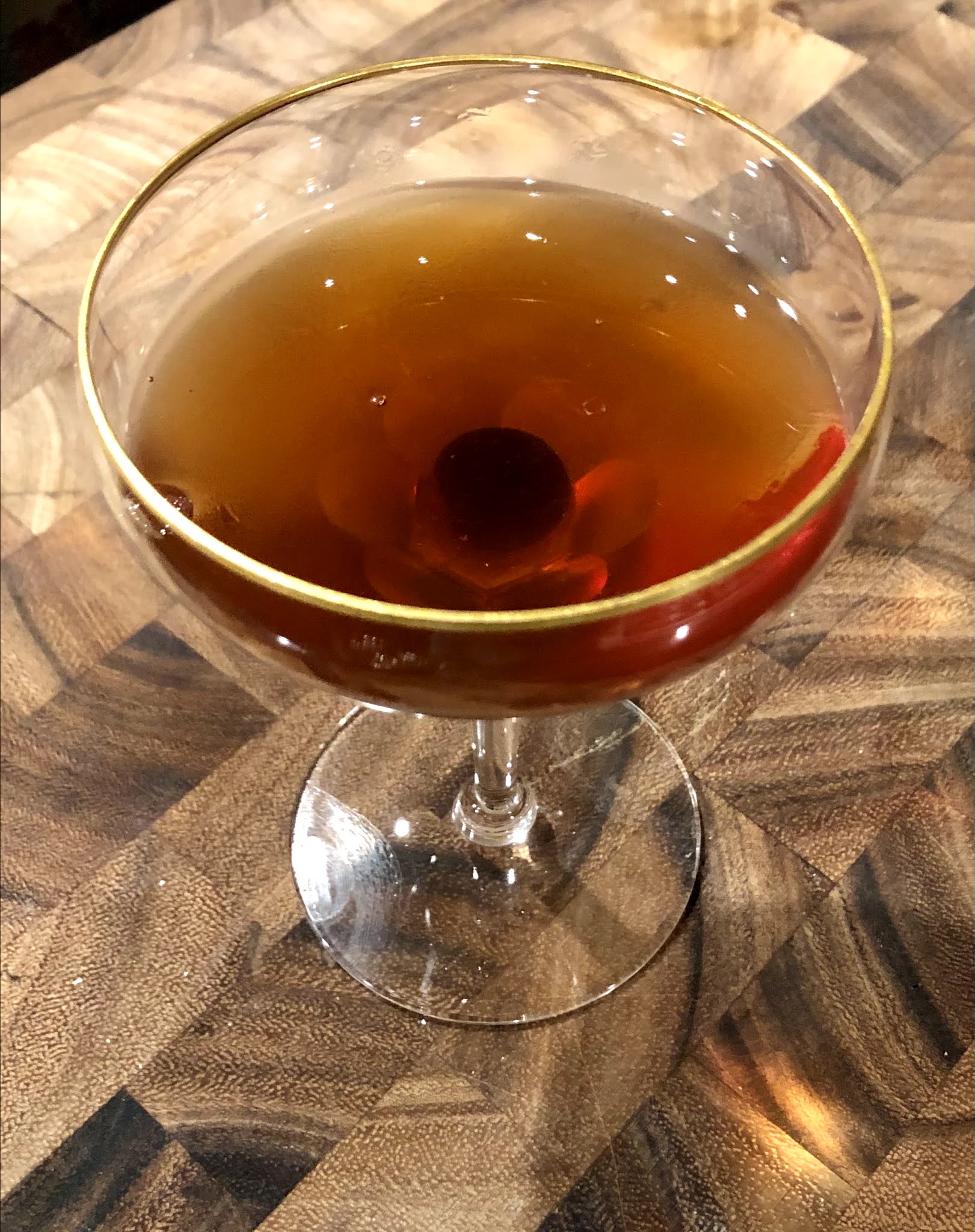
After making pasta for dinner, I found myself with a mostly bare lemon that really needed to be used up. While I found a few good suggestions for pairing it with vermouth, none of them were speaking to me until I found the Man o' War cocktail. Named after a champion race horse, it takes the classic proportions of a Manhattan and accents them with balanced amounts of orange liqueur and lemon juice. Looked at another way, it's simply a Derby that uses lemon juice instead of lime. However, as written, it just looked like more alcohol than I want to be consuming right now, so I wondered if I could flip things around to make a less potent but still tasty drink.

Reverse Perfect Man o' War
 
1 oz  sweet vermouth
1 oz dry vermouth
1 oz orange liqueur
0.5 oz rye whiskey
0.5 oz lemon juice

Combine all ingredients, shake with ice, then strain into a double old fashioned glass filled with ice. Garnish with maraschino cherries if desired.

The aromas are driven by the sweet vermouth, accented with dry vermouth, lemon, and a touch of orange. The sip opens bittersweetly with vermouth, lemon and orange dancing around each other, shifting towards herbal notes in the middle. The finish opens with rye spice and grain, then shifts into tart dry vermouth and lemon.

Wow, this is a great drink. I've had really good luck with the reverse perfect formula for stirred drinks, but I wasn't sure if it would work for a shaken drink. This does exactly what I wanted it to do - provide a lot of engaging complexity without straying too far in any one direction. For all the sweet ingredients the dry vermouth and lemon keep them in balance. The one change I'd make next time is to serve it up rather than on the rocks. While I think it makes for a refreshing warm weather drink on ice, it does compromise the complexity a bit.

Monday, January 18, 2021

Classic Cocktails: Reverse Perfect Manhattan

The Manhattan is one of the Ur-classics of the cocktail world - its simple ingredients and proportions encapsulate the late-19th and early-20th century drinks zeigeist in the same way as the Martini. One of the earlier variations was the Perfect Manhattan, using a split of both sweet and dry vermouth to take some of the sweetness out of the drink for those with a drier palate. The Reverse Manhattan (or, perhaps, the Original Manhattan) performs another flip by inverting the proportions to more vermouth than whiskey.

Inspired by an article from Kara Newman and my current search for low(er)-alcohol cocktails, I wondered what would happen if the two variations were put together. Especially with big, flavorful vermouths like Cocchi di Torino, I could imagine the whiskey getting lost. But with a slug of lighter, less rich dry vermouth to keep things in check, maybe the results could be even better. The Diplomat had a similar split of dry and sweet vermouths, though in that case the sweet was acting more as a flavoring agent like the gin in a Reverse Martini. 
 
Perfect Reverse Manhattan
 
0.75 oz dry vermouth
0.75 oz sweet vermouth
0.5 oz American whiskey
2 dashes Angostura bitters
 
Combine all ingredients, stir with ice for fifteen seconds, then strain into a chilled cocktail glass and garnish with several cocktail cherries and a smidge of syrup.
 
The aromas are driven by the dry vermouth and inflected with rye spice and grain plus a little roundness from the sweet vermouth and cherries. The sip begins with vermouth and cherry sweetness, sliding through dry vermouth tartness into pleasant bitterness and rye spice towards the back. The finish is Angostura and vermouth bitterness plus a bit of grape roundness in the background.

This turned out exactly the way I hoped it would, with the various components in pleasant balance. Looking at the structure there are a few ways to adjust it to your preferences - the ratios of the vermouths can be tweaked to make it sweeter or drier and differing amounts of syrup can be added with the cherries to provide a different kind of sweetness. However you choose to make it, this is a full-flavored drink with less of a punch to the liver.

Wednesday, January 13, 2021

Classic Cocktails: The Diplomat

In my attempts to ease back into cocktails and alcohol in general I went searching for low alcohol drinks that were made mostly with vermouth. Thankfully I was gifted a copy of The Art of the Shim a few years ago, which I had largely forgotten about when I was primarily drinking neat spirits.
 
While perhaps apocryphal, the suggestion is that this drink was meant to provide diplomats with something delicious to sip without getting them so deep in their cups that they let the wrong words slip out in front of the wrong people. Whether or not that's true, it absolutely gets the job done.

The Diplomat
 
1.5 oz dry vermouth
0.5 oz sweet vermouth
0.25 oz maraschino liqueur
2 dashes Angostura bitters

Combine all ingredients, stir with ice for ten seconds, then strain into a chilled cocktail glass and garnish with a strip of lemon peel.

The nose is a pleasant melange of richness from the sweet vermouth, spices from the bitters, and funk from the maraschino, plus some background sourness from the dry vermouth. The sip opens in a balanced fashion between sweet and tart, a pleasantly citrus and apple flavor in the middle, slowly fading into complex bitterness and increasing tartness towards the back. The finish leans into the dry vermouth, with some pleasant bitterness.

This is an incredibly pleasant drink. It makes me think of a reverse Manhattan/Martini style cocktail where a small amount of a more robust spirit is used to modify the base vermouth, but in this case the modifier is also vermouth. As recommended in Shim, you really want a big, robust sweet vermouth - I used Cocchi di Torino, but Carpano Antica or Punt e Mes could work just as well. In tandem with the maraschino they're enough to round out the more tart dry vermouth without completely overwhelming it. The result is refreshing while maintaining a very classic spirit-based profile. Overall I would highly recommend this if you want a full cocktail experience without taxing your liver.

Monday, January 11, 2021

Non-Alcoholic Review: Giffard Aperitif Sirop

Hey, so it's been a minute. Reviews stopped last fall because I have barely been drinking. Back in September, the Pacific Northwest experienced one of its worst fire seasons ever. Numerous wildfires, especially in Oregon, blanketed the region with a thick layer of smoke for several weeks. Air quality numbers reached levels almost never seen before, sometimes pegging out the instruments. While I got off fairly lightly in the scheme of things due to an already installed HEPA filter in our HVAC system, I don't think I was unscathed. I had a low-grade headache for weeks, even after the smoke had cleared. And it rapidly became apparent that alcohol was a major trigger.

After a few unpleasant experiences I just stopped trying to consume any alcohol and it slipped out of my regular rotation. No whisky samples quietly sipped on the weekend, no aperitifs while I cooked, or post-dinner drinks to settle my stomach. I would periodically give it a try, which would usually provoke another nasty headache. Eventually it just completely fell off.

So I was rather excited to see a tweet from Camper English about Giffard's Aperitif Sirop. As the name suggests, this is built to mimic classic aperitif spirits like Campari or Aperol, but without any alcohol. I poked around the internet for a while, but didn't really want to pay shipping for a single liter bottle from out of state. Lucky for me, I guessed that I had seen other Giffard syrups at one of my local liquor stores and found it while picking up a Christmas present.
 
As a basic Campari substitute, it does alright. With soda water and a bit of lemon peel the aromas are rather faint - berries, coffee, lemon. The sip begins sweetly with slightly artificial berry notes, switches to a syrupy vanilla thickness in the middle, then crashing into a wall of bitterness with citrus overtones at the back. While this recapitulates the basic form it's seeking to imitate, there are definitely limitations. It doesn't have the same aromas or nuance, likely limited by the solvent effects of being a zero proof syrup.

With that said, if you're really trying to stay away from alcohol this is a totally legit substitute. Some of its deficiencies can be remedied with bitters to add more complexity and offset the sweetness. Used to reduce the proof of a multi-ingredient drink can also cover up some of the defects. Overall I think this is a really good tool to have in your kit, especially for bars looking to cater to abstemious guests.

Wednesday, September 23, 2020

L'Affaire de Murray, or Why Now, What Now?

Anyone connected with the whisky community is likely to have seen some of the furor raised by Jim Murray's latest edition of the Whisky Bible. While he has developed a reputation for sexism over the years, the florid prose of his latest edition has taken that to new heights, drawing comparisons with the Bad Sex in Fiction Awards. A full-throated denunciation by Becky Paskin and a piece in Forbes by Felipe Schrieberg kicked off a wave of responses, both from individuals and companies.
 
Murray's response has, unsurprisingly, leaned into the now stock language used when people are called out, referencing 'free speech', 'cancel culture', and 'trumped up charges'. While his dignity seems to have taken a body blow, there appears to be very little self-reflection about why using overtly sexual terms to describe whisky might be off-putting or exclusionary for others. Equally unsurprising, there have been any numbers of whisky fans who have also leapt to his defense, calling anyone bothered by the language 'SJWs' or humorless. Others have been accused to using the situation to take Murray down a peg to promote their own work.
 
Sometimes in a less reactionary fashion, some have asked simply "Why now?" While his language is perhaps more overwrought that before, it's a difference in degree rather than in kind. This partially elides the fact that he is now forced to self-publish his work and has been progressively banned from whisky events, but it can be explained by Broken Stair Theory.

Especially in insular communities, it's very common to have problematic people who are explained away with "That's just how they are." New entrants may be quietly warned and the problem person may be slowly disinvited from events, but the majority either actively supports them or simply accepts their presence and learns to work around them. It's not until someone is willing to speak up and say "This isn't right. Why is this person still here?" that you can trigger the avalanche that finally leads to change.

What this really comes down to is who we want to be in community with, because there is exclusion in either direction. For decades the enthusiast community has tacitly allowed or even supported sexist behaviors, all the way from overt harassment to the all too common jokes along the lines of "Don't let my wife find out how much I've been buying". Assuming that women are less knowledgeable than men, describing whiskies in overtly sexualized terms, labels with scantily clad women - we've all seen this at some point or another and sighed, knowing that every single instance made women feel less welcome to participate.

The only solution is to make that kind of behavior unacceptable. You can't always change hearts and minds, but you can change behavior. No community can survive intact without moderation, because without filtering mechanisms the most boorish individuals will inevitably come to dominate. If we want to make the community inclusive, we're going to have to be a little bit exclusive. 
 
That doesn't mean dismissing people for the smallest infraction, it means that if people want to remain after making a mistake they have to be willing to own up and make genuine efforts to change. There will absolutely be a hue and cry, especially in the current political environment, but we have to make a choice. Opening up the community to the broadest possible slice humanity means that we can't keep the people who create an actively hostile environment around.

Tuesday, September 1, 2020

Madeira Review: Rare Wine Co Boston Bual

While malmsey was my introduction to madeira, bual was not far behind. While I wasn't overly impressed by Blandy's 5 Year Bual, this should be much older and hopefully more complex.

While not as sweet as a malmsey, this should be much sweeter than a verdelho or a sercial. This wine is fermented to more than 50 g but less than 100 g of residual sugar per liter, fortified, and aged in oak in a traditional canteiro system. The blend is put together from 85% bual grapes aged for 15-20 years with 15% tinta negra mole grapes aged for 40-60 years, then bottled at 19.5% ABV.

Rare Wine Co Boston Bual

Nose: big dried fruits, fresh grapes, raspberry, plum, melon, a sour top note, floral, a little fresh wood, soy sauce, and bubble gum

Taste: moderate grape sweetness up front, apples, pears, and berries in the middle, a moderately tart finish with tea tannins and lemon peel

Finish: a little thin, citric/vinegar tartness, grape sweetness, a little bit of vanilla roundness

This is definitely the transition point where the madeiras switch from being aperitifs to dessert wines. While there is still plenty of acidity to counterbalance the sweetness, it has firmly switched from being dry to sweet.

My first impression was that this was something of an awkward middle. It didn't quite seem to have the complexity of the sercial or verdelho, but it also didn't have the magnificent sweetness of a malmsey. Subsequent tastings have improved that impression, so I feel like it holds its own in the lineup. I can also see some parallels with the Blandy's Bual I mentioned above, though as I hoped this has more complexity. It makes a solid after dinner drink for a not overly rich meal.

Friday, August 28, 2020

Madeira Review: Rare Wine Co Savannah Verdelho

While I have tried a verdelho or two before, most of my madeira experience has been firmly between malmseys and buals. I was really curious to see how this one would stand up, especially after the rather tart sercial

While not as dry as sercial, it has less residual sugar than a bual and much less than a malmsey. This wine is fermented to more than 50 g of residual sugar per liter, fortified, and aged in oak in a traditional canteiro system. The blend is put together from 85% verdelho grapes aged for 15-20 years with 15% tinta negra mole grapes aged for 40-60 years, then bottled at 19.5% ABV.

Rare Wine Co Savannah Verdelho

Nose: big, dark grape notes trending towards molasses, some brighter green apple acidity behind it, a little floral vanilla, mixed nuts, a touch of barnyard, stewed fruit, ripe stone fruit

Taste: bright and balanced grape sweetness with vinegar and citrus tartness up front, becomes thicker and more molasses-y with fresh berries and apples plus a touch of vanilla around the middle, then a relatively clean apple tart fade out at the back

Finish: tart grapes, a little tannic bitterness, some musty savory notes

While still not particularly sweet overall, this is much more approachable than the sercial and will probably appeal to fans of medium dry amontillado sherries. I'd be happy to reach for it, especially as an aperitif because the tartness makes it nice before a meal without being too puckering. While not the most complex madeira I've tried, this is still a quality product that justifies its price point reasonably well. And, unlike some of the more impressive colheitas I've had, this should be pretty widely available.