Showing posts with label Arran. Show all posts

Thursday, April 30, 2020

Whisky Review: G&M Connoisseurs Choice Arran 8 Year 1998/2007

Not too long ago Arran seemed like the new kid on the block. With the exception of Kilchoman, it had been one of the only truly new distilleries in Scotland for quite some time until the spate of new construction during the last decade. This spirit was distilled within a few years of their founding, which also happens to be the era when many of the single casks in my cabinet were distilled. So I was pretty happy to find this bottle for what was something of a bargain price at Clearview Spirits & Wines not long after Washington privatized their liquor system. Miraculously they also offered shipping to Oregon, which saved me a fairly long drive.

This whisky was distilled in 1998, filled into 'oak casks' (probably refill ex-bourbon casks, but maybe tired sherry casks), then bottled in 2007 at 46% without coloring or chill filtration.

G&M Connoisseurs Choice Arran 8 Year 1998/2007

Nose: very malty, a little caramel/toffee, vanilla, light oak, earthy/herbal, a little new make, vague floral notes. After adding a few drops of water the floral notes are amplified and become more perfume-y, while the new make notes turn into green fruits (apples/pears).

Taste: opens with balanced malt and cask sweetness with light berries, creamy citrus peel (orange?) starting right behind, fading through some light floral malt near the middle, then very light oak tannins going into the finish. After dilution the sweetness is amplified and carries further back, the oak becomes almost sherried in the middle, and there's a sort of funky floral/herbal/malty note at the back.

Finish: a little hot, fresh malt, caramel, gently herbal

While not a stunner, I've found this to be a rather pleasant malt. The casks weren't exceptional, but the quality of the spirit still manages to shine through. If you're not already a fan of Arran I'm not sure this has a ton to offer you, but it's a pleasant reminder for me of how much I enjoy what they've been putting out.

As with many other bourbon cask Arrans, I also found it to be a solid platform for blending. A little sherry cask malt smooths out its rougher edges, while peat takes it in a more herbal direction. Or you can do both, like I've found adding Benromach 10 Year to it.

Overall it's not worth being sad if you missed out on this particular bottle. There are plenty of other ways to get your hands on younger bourbon cask Arran, though that is more challenging if you'd like to try something from their earlier years of production. But I've found Arrans to be pretty consistent, so my guess is that their current output will be as good or better.

Friday, September 9, 2016

Whisky Review: Arran 12 Year Cask Strength Batch #5

Starting with Batch #3 Arran switched their 12 Year Cask Strength release from all sherry casks to a mix of ex-sherry and ex-bourbon casks. While they stopped giving information about the relative proportion of each cask type, they have settled into a steady pattern of first-fill ex-sherry butts, refill ex-sherry hogsheads, and first-fill ex-bourbon barrels for the components.

This whisky was bottled at 52.9% without coloring or chill filtration.

Thanks to my mother for letting me snag a sample after I gifted her this bottle for Christmas.

Arran 12 Year Cask Strength Batch #5

Nose: strong but not overwhelming bourbon cask influence (caramel, oak, vanilla), clean Arran malt, subtle sherry, light floral notes. After adding a few drops of water the sherry is amplified and integrates with the other notes, an earthy dankness, fresh apples, Middle Eastern-associated spice notes, and a touch of cured meat appear, the oak is a bit stronger, and it is drier overall,

Taste: malt and wood sweetness throughout, undergirding oak, wood spices, floral notes, and slightly dank sherry appear around the middle, creamy caramel and dark chocolate with a bit of pineapple near the back. After dilution the sherry comes in immediately and is much stronger, while retaining the creamy malt and bourbon cask character underneath, and the wood becomes spicier.

Finish: sherry residue, sweet malt, bittersweet oak, dark chocolate, floral/herbal

In comparison to Batch #2, the bourbon casks in this version are very noticeable. There's more vanilla and the malt is a more significant component as there is less sherry influence to cover it up. Overall this puts it more in line with their standard 10 Year and 14 Year expressions, which are also combinations of sherry and bourbon casks. While I think they've achieved an excellent balance and the sherry can be amplified by adding a touch of water, if you were a fan of the more sherry-driven earlier releases this might not hit the mark quite as well. On the other hand, I tried the two batches side by side when the bottle were first opened and Batch 5 was much more drinkable from the start, whereas Batch 2 needed a number of months to settle down from its initial furnace blast of alcohol heat. Part of me wishes that they would do separate all-sherry and all-bourbon cask strength expressions as a replacement for the young-ish sherry and bourbon single casks that they released about five years ago, but this is a totally decent compromise. In an industry that has been dropping age statements left and right, I commend Arran for putting out something that clearly competes with NAS cask strength expressions from other distilleries at a competitive price.

Wednesday, September 7, 2016

Whisky Review: Arran 12 Year Cask Strength Batch #2

Arran's 12 Year Cask Strength line began in 2012, which was designed to compete with other distillery's sherry-driven cask strength whiskies. But unlike most of those, it has an age statement and they have also given information about the types and proportions of casks used to make each batch. Surprisingly, they have also managed to do this while releasing the 12 Year Cask Strength at a comparable or lower price than many of those other NAS whiskies.

Batch #2 was constructed very similarly to Batch #1. 17 first-fill sherry butts and 4 refill sherry hogsheads were combined, then bottled at 53.6% without coloring or chill filtration and released in September 2012 in an outturn of 13,200 bottles.

Arran 12 Year Cask Strength Batch #2

Nose: big sherry influence, rich raisin notes with a savory edge, spicy oak in the background, sweet berries and malt, creamy vanilla. After adding a few drops of water the sherry settles down a bit, some chocolate emerges, the malt and oak come through more clearly, and the raisins become more savory.

Taste: thick, similarly big sherry throughout with baked apples and peppery spiciness behind it, hints of barrel char, somewhat monolithic - not a lot of development. After dilution the sherry settles down a bit and gets sweeter/juicier, a bit of creamy malt shows through, the oak and pepper shift towards the back, and some savory character comes out.

Finish: sherry residue, malt, gentle oak, fresh apples, milk chocolate

While not particularly complex, this hits the important notes for sherry-driven whiskies. It's pretty hot at full strength, but a little water settles it down nicely. But as further dilutions will show, you want to be careful with how much you add.

Batch #2 at 50%

Nose: clean malt, fresh sherry, slightly savory, sulphur/egg/lard, herbal/vegetal

Taste: sweet sherry throughout, a rising tide to oak from the middle bolsters but doesn't overwhelm the sherry, a bump of clean malt near the back

Finish: sherry, bittersweet, oak tannins, cacao nibs

This is a fairly clear extension of the full strength malt, but simplified even further. Most of the heat has been taken out of it, but it hasn't completely collapsed. There's something sulfurous on the nose that could be off-putting, but I don't find it wholly objectionable in a Tobermory-ish fashion. Overall, neither here nor there.

Batch #2 at 45%

Nose: faint and sherry-driven, sour, mild oak, malt in the background but growing with time, slightly herbal/floral, musty

Taste: bittersweet opening trending towards bitter at the back, sherry in the beginning fading into dry grain, floral overtones beginning in the middle, somewhat unpleasant sourness near the end

Finish: slightly off, sour, bitter sherry residue, freeze dried coffee, young malt, dried flowers

It's been my observation that the casks picked for Arran's cask strength releases are selected not just because they work well at full proof but also because they do so poorly when diluted. While the nose retains some appeal at this strength, the palate and finish almost completely fall apart.

This was clearly built to go toe-to-toe with the big sherry monsters from other distilleries. I first tried the Cask Strength at the distillery and found it to be one of the best whiskies in their lineup, even in comparison to older single casks or their Devil's Punchbowl release. While I have mostly retained that impression, I do thing it has a few flaws. Most noticeable is the fact that it starts off really hot. I opened this bottle around Christmas 2015 and it took a number of months to settle down and become more easily drinkable. At this point it's a really solid whisky and something that I would have recommended if it hadn't sold out years ago. But the series has continued and I'll be reviewing Batch #5 soon to see how it has evolved.

Monday, September 5, 2016

Whisky Review: Arran 10 Year (2014)

I've reviewed the previous version of Arran 10 Year twice before and still have one more bottle hiding in the back of my cabinet, so it's safe to say that I really enjoy its profile.

I've seen some suggestions that the the cask mix has changed from all ex-sherry casks (though I'm pretty sure they were mostly refill casks) to a combination of ex-sherry and ex-bourbon casks, but I've been unable to get confirmation.

Thanks to Michael Kravitz for the sample.

Arran 10 Year (2014)

Nose: very floral, pink, medium weight sherry, berry jam, green malt, vanilla, milk chocolate, citrus peel. After adding a few drops of water it becomes more grain focused and less complex, the sherry is a distant hint, but some woody spices do come out.

Taste: malt sweetness with an undercurrent of sherry throughout, strong floral overtones, creamy vanilla, a light citrus tang and berries in the middle, bittersweet oak and grapefruit peel at the back. After dilution it becomes less sweet, grainier/grassier, and more bitter.

Finish: creamy malt, floral, gentle oak, grassy, grapefruit peel

While the cask mix may have changed, the blenders at Arran have done a fantastic job of maintaining the quality and character of the expression. While I feel like I can get some more bourbon cask influence out of this, it doesn't stick out or overwhelm the spirit character. With that said, I'd hold the water as it seems to fall apart with even a little dilution.

Friday, July 10, 2015

Experimental Whisky: North British/Arran/Tamdhu/Hazelburn/Bunnahabhain Blend

One of the main goals of in making blends is creating balance - carefully adding more flavorful malts to grain whisky. When that comes to peat and sherry, a little goes a long way. So this was my attempt to add a bit of everything, hopefully keeping any one element from dominating the others, at a respectable but not overwhelming strength of 46%.

•15 mL Signatory North British 16 Year CS
•5 mL Arran Bourbon Single Cask
•2 mL Signatory Tamdhu 8 Year CS
•1 mL Hazelburn 8 Year CS
•1 mL Chieftain’s peated Bunnahabhain 16 Year CS for K&L
•5 mL H2O

North British/Arran/Tamdhu/Hazelburn/Bunnahabhain Blend

Nose: grain with a mossy peat edge, a whiff of sherry and fresh soil, a little green, cured meat, gentle oak, seashore, vanilla. After adding a few drops of water, there is more grain and peat, plus something nutty emerges.

Taste: sweet grain and malt with bourbon cask influence up front, vanilla/floral/vegetal in the middle, sliding through mild sherry influence at the back. After dilution, it becomes more integrated - the sherry shifts forward and the peat arrives earlier.

Finish: grain, peat, oak

This blend hews most closely to the recipe set out by Alfred Barnard than any other I've made, though it is even more grain-heavy, making it more akin to modern commercial blends. The balance of grain whisky, bourbon cask malt, sherried malt, and peated malt is just right. Every element is present, but none dominates, providing a pleasant but relatively unchallenging experience. The flavor density is solid given the final proof, but it reads as fairly smooth. This is what I want blends like Johnnie Walker to be, but they never quite seem to get there. Nice to know that I can do for self.

Wednesday, April 15, 2015

Experimental Whisky: Tamdhu 8 CS/Hazelburn 8 CS/Arran Bourbon Single Cask/North British 16 Year

After writing my post about blending whisky, I decided to try making a blend with a bit more precision.

This is a roughly even (a milliliter or so off in some cases) split between an Arran Bourbon Single Cask, Signatory Cask Strength Tamdhu 8 Year, Hazelburn 8 Year Cask Strength, and Signatory North British 16 Year for Binny's. All said and done should clock in around 58% and all of the component whiskies were uncolored and un-chill filtered.

Blended Whisky #1

Nose: a thick layer of sherry on top, sweet raisins, fresh malt core, a touch of grain, light vanilla, caramel/brown sugar, something a meaty/savory, a bit of Campbeltown brine, sawdust. After adding a splash of water, the sherry is toned down significantly, letting the dusty grain, brine, and meaty notes shine.

Taste: fruity/dank sherry rides on top of everything, green/lightly peaty/earthy/dirty with dried orange peel and a heavy seasoning of black pepper around the middle, slides into malt/grain, mild oak, and extra pepper. After dilution, the sherry becomes a lighter bottom note rather than a top note, with malt and grain dominating, while the oak almost disappears and the earthy peat becomes stronger at the back.

Finish: grainy bitterness, moderate oak, sherry dregs, hints of dirty peat

This fudges Alfred Barnard's classic recipe, but it's close. One Speysider, an Island distillery that hews fairly close to Speyside/Highland, a Campbeltown, and a well-aged grain. Something peated from Islay definitely would have given this more punch, though I was pleasantly surprised by how much of that the Hazelburn brought to the mix. Also surprising was how strongly the sherry from the Tamdhu came through over the other three bourbon cask whiskies. Trying the Tamdhu by itself I found it to not be very intensely sherried, but mixing it with the other three seems to bring that element to the fore. Goes to show that how a malt whisky behaves on its own is not necessarily indicative of how it will behave as part of a blend.

Monday, April 6, 2015

Whisky Review: Arran 10 Year Revisited

Arran has long been one of my favorite distilleries (it was a lot of fun to visit back in 2013) and the quality of their entry-level 10 Year (well, I think they have an NAS release now, but it's not available in the US) has been a significant part of that. I opened a new bottle for a whisky tasting I held a few months ago as an example of an island whisky that doesn't fit the usual mold of Talisker, Highland Park, or Ledaig.

The 10 Year is made from whisky aged in ex-sherry casks, though I'm guessing that they're all or almost all refill casks as the sherry influence is very mild. It has always been bottled at 46% without coloring or chill filtration. This bottle appears to have been bottled on 10/05/11, so the flavor profile may have shifted slightly in more recent releases as they have a deeper stock to work with.

Arran 10 Year

Nose: gentle floral-inflected sherry notes over creamy fresh (slightly green) malt, mild oak, raspberries, apples, a bit musky with a touch of Ivory soap, lemon/lime peel, vanilla, cotton candy, and mint. After adding a few drops of water, it become more malt- and oak-focused, reading more like a bourbon cask malt.

Taste: malt sweetness with a thin layer of musky sherry and floral overtones up top, berries and fresh raisins near the front, becoming more malty with a touch of oak around the middle. After dilution it becomes sweeter up front but less sweet at the back, with the sherry fading a bit until the end, with the oak waxing and the malt gets some roasted flavor, making it darker overall.

Finish: malt, sherry residue, grain/oak bitterness, vanilla

While this whisky can occasionally come off as a bit youthful, I think that the somewhat spare nature is fitting with the distillery's philosophy of letting their spirit shine through any cask influence. Arran has almost always put out malt-forward whiskies, which is somewhat rare in the current paradigm of wood-driven releases. I think this would be a good choice for people who enjoy whiskies like Balvenie Doublewood as they both have a similar level of sherry influence.

In comparison to my first go with Arran 10 Year, I didn't find any peat this time and I think that's both because I'm much more tolerate of peat flavors now so my threshold is higher and because I may have been mistaking some of the fresh barley character for peat. I also didn't get any brine, but who knows why. Otherwise my notes from three and a half years ago are pretty consistent, which suggests that Arran 10 Year is a whisky I'll keep coming back to and enjoying, even as I try more new things.

Monday, March 10, 2014

Scotland 2013: Islay to London

After almost two weeks in Scotland, I was simultaneously becoming burned out on distillery tours (you can only see so many mash tuns before they start blurring together) and lack of familiar faces. My original plan had been to ride from Islay to Oban, then up to Mull, before heading back to Glasgow. However, a number of my friends had recently moved to London, which gave me a great excuse to change those plans.

The most amazing part of this was my ability to turn on a dime - I was able to cancel both of my B&B reservations by email (which thankfully didn't incur any charges) and book tickets from Glasgow to London via Scotrail, all while poking at my iPhone in my room in Ballygrant.

I was a little bit scared by my new plan - it required linking together three stretches of biking, three ferries, and two trains with a fairly small amount of time in between each.

The very nice dog who kept my bike company at the Ballygrant Inn
Thankfully I was able to settle my bill the night before and arrange to have a few sandwiches made up for me, which were left at the front desk with my bike for me to pick up in the morning. The ferry left Port Askaig, about four miles away, at 7 AM sharp, so I was up and out the door by 6:30. Thankfully it wasn't doing much more than sprinkling while I pushed down the road in the pre-dawn darkness, carefully easing down the steep descent to the ferry terminal. Thankfully I made it with a bit of time to spare and purchased tickets for the three legs of my journey that would be provided by CalMac.

After securing my bike on the car deck, I trooped upstairs for a hot Scottish breakfast. I had a couple of hours to relax and let the calories work their way into my body as I prepared for the next part of my trip. The sun was up but the rain had set in by the time I rolled off the ferry at Kennacraig. It was a fairly short hop to my next destination of Claonaig, but it required going over the hilly spine of the Kintyre Peninsula. I was fairly energized from breakfast, but the hills presented something of a grind, especially since I was quickly soaked by the rain. The descents were also a bit worrying, since I was never quite sure how well my brakes would work, but I eventually found myself at the tiny landing at Claonaig and was able to sit down and rest in a shelter for half an hour or so. The ferry eventually emerged from the mist and pulled in to shore, so I was once again able to lash my bike to the deck and hunker down inside.

This was the reverse of the trip I had taken a little over a week before and the passage was thankfully just as swift. We soon docked at Lochranza, where I threw on some extra rain gear and prepared myself for the longest ride of the day. I was sad to have to pass by the Arran Distillery as I would have loved to stop by for a dram, but I was more than a little worried about making the next ferry as I knew how much work it had been going the other direction.

Something tells me they don't understand the full meaning of that flag
It didn't take long after hitting the first big hill above Lochranza to start feeling how much I had lost over the last few days of being sick and not eating enough. My legs just didn't have the oomph that I had started the trip with, which made the going even harder. Near the crest, I ended up slowing down to chat with a Frenchman who was walking the same route that I was taking. We had a good talk, but eventually I had to press on. It was an absolute relief to start descending into North Sannox Burn as I knew the going would be much easier from then on. The road was almost entirely flat as I hit the coast again, which was made all the better by the rain letting up. I stopped to shed my rain gear and continue on. As I got closer to Brodick, it became a race as I could see one ferry leaving the dock and the one I wanted to catch coming in. I reached the dock with a huge sense of relief as the ferry was pulling in just as I rolled into the town.

The downside was that it was also running a bit late. I knew I had to arrive at Ardrossan on time to catch the train I wanted back to Glasgow, so I grew increasingly anxious as the minutes drew on. I was also fairly wiped out from pushing so hard across Islay, so I was very thankfully to get a bowl of mac & cheese on the ferry to refuel. After that I unceremoniously flopped on a comfy bench to wait out the rest of the trip.

I was itching to get off the ferry as soon as we touched the dock, as there were only a few minutes left by my reckoning to catch the next train. I dashed to the station, but no luck. I was somewhat crestfallen, as the subsequent train would not arrive for nearly an hour. However, this made me extremely thankful that I had been unable to reserve a spot in the baggage car for my bike on an earlier London-bound train from Glasgow, which gave me an extra hour of wiggle room. Eventually the Glasgow-bound train did arrive and I was able to get on my way. I was once again somewhat anxious, as I knew this would not give me a lot of time to get off the train, get my ticket, and get on the train to London when I arrived at Glasgow Central. It was also slowed down by the fact that ticketing had been impossible on the train to Glasgow, so I was slowed by having to pay at the station behind everyone else who was also trying to get on their way. Thankfully I was able to get my ticket printed and find my Virgin Train with a few minutes to spare.

It was finally possible for me to relax a bit. I had done the nearly impossible and it was just a matter of waiting. I ponied up for internet access on the train, which let me get in touch with my friends in London to let them know that I was on my way and to pass the time while the Scottish and English countryside slipped by.


I finally got into London a bit after sunset, then set out to navigate the London streets to find my friend's apartment. It was a little disconcerting to be surrounded by so many cars and people after more than a week in the Scottish islands, but I successfully found where I needed to go. After a bit of texting and a much-needed shower, the motley collection of folks all trooped off for late night Japanese food. I had a full day of London ahead of me, so sleep was not too long in coming after dinner.

Wednesday, February 19, 2014

Whisky Review: Arran Bourbon Single Cask #77 1999/2010

Arran has been one of my favorite distilleries, helped by the fact that the OLCC bought a large number of their whiskies around 2010 and were then unable to shift them, which resulted in hefty markdowns over the last year or two. I have been taking full advantage of this fact.

Some of the best deals have been Arran's Single Cask releases. I've previously reviewed one of the Sherry Single Casks, but this is the first Bourbon Single Cask I've tried.

If you live in Portland or can make it out here, I believe there are still one or two more bottles of this cask left at the 11th & Hawthorne liquor store for under $60, which is a steal for single cask, undiluted whisky these days.

The spirit was distilled on 19/07/1999, only a few years after the distillery was established, and bottled on 19/11/2010 at a hefty 57.0% from an outturn of 206 bottles.

Arran Bourbon Single Cask #77

Nose: distinctive Arran malt, green fruits (apples, pears, pineapple, grape), vanilla, floral (primarily rose), fudgy, brown sugar, a touch of residual new make character, cinnamon, very light oak, raisins, grassy.

Taste: sweet malt front and back, prickles of oak and apple/pear at the beginning, turning into sweet floral notes, pepper, caramel, and alcoholic heat close behind - with time there is a certain added thickness to the mouthfeel and a shift towards barrel influence.

Finish: sweet malt, vanilla, lingering alcoholic heat, hints of berries, peppery bittersweet oak

This is what I was looking for when I picked up the bottle. The roughly 11 years in oak have been just enough to round off the edges of Arran's spirit without overwhelming it, providing an exceptionally clear picture of the distillery's character. Given the light oak impact, I'm guessing this was a refill cask. I wouldn't say that it's particularly complex - more time might have helped on that front - but it's an engaging sort of simplicity.

I will admit that I have to be in the right mood for this one. Sometimes the alcoholic heat seemed overwhelming, which made it less than enjoyable. Time in the glass seems to mellow it out a bit, so waiting a few minutes before taking that first sip may be the key.

Following some previous posts, I've decided to make a habit of tasting cask strength whiskies diluted down to lower strengths to see how the spirit changes. Dilutions were allowed to integrate for several weeks before sampling.

Arran Bourbon Cask #77 at 50%

Nose: fairly closed, moderately green, cinnamon, vanilla, light caramel, creamy malt, perfume/floral, apple skins

Taste: rather green throughout, lots of sour floral esters and vanilla - kind of like low grade perfume, noticeable but not heavy oak, some sweet chocolate sauce (but not enough to counter the vegetal notes)

Finish: cheap perfume, creamy malt, vanilla, bitter oak and vegetation

While I generally find that floral notes are one of the better aspects of younger bourbon cask whiskies, at this strength they have taken a turn for the worse. There's something artificial about their character here that really does remind me of cheap perfume - they seem disjointed, unlike more the more balanced floral character in other whiskies. I'm beginning to see why this cask was selected for bottling at full strength - it shows more rough edges being watered down.

Arran Bourbon Cask #77 at 45%

Nose: very green - lots of malt and fruity (apples/pears/grape) esters, very little barrel influence, creamy cinnamon/floral notes, graham crackers

Taste: rather immature - lots of green malt and vegetal sharpness, creamy cinnamon/vanilla graham crackers at the back, malty sweet with a vague sense of grape flavors throughout, oak hits inside vegetal flavors near the back

Finish: vegetal/green bitter malt, freshly felled oak

More water seems to shift this whisky even more towards its origins, emphasizing the malt over the barrel. While it doesn't have the odd floral perfume notes found at 50%, the vegetal smells and flavors were even bigger. The accompanying decrease in perceptible barrel influence makes the whisky seem younger than its years.

In conclusion, I really do think this whisky is best at full strength. While dilution was an interesting exercise, I can't say that either 50% or 45% were better than cask strength in any way shape or form. It was educational, but I wouldn't want to drink the whisky that way all the time.

For another perspective on this whisky, check out Michael Kravitz's review.

Wednesday, February 5, 2014

Whisky Review: Arran St. Emilion Finish

In an earlier phase of the distillery's history, Arran was known (infamous?) for releasing a plethora of different cask finishes. The basic idea was to take relatively young (~8 years old) bourbon cask whisky and transfer it into another cask for a period of 'finishing'. This would add new flavors to the whisky that hopefully complement the distillery character to make something new and exciting.

Fast-forward a few years and the cask finishes have been pared back to three expressions: Sauternes, Amarone, and Port (which I reviewed a little while ago). All of the others were deemed unsuitable for regular release.

Luckily for me, I can still try a number of the less successful cask finishes at the Highland Stillhouse, as I'm quite curious to see how they turned out. This one began its life as eight year old ex-bourbon cask whisky and was then finished for twelve months in Saint-Émilion Bordeaux wine casks from Chateau Fonplegade before being bottled at 50% ABV.

Arran St. Emilion Finish

Nose: Arran maltiness, red wine undertones, rich caramel, light vanilla, chocolate, a bit jammy, a little green, very light oak, and maybe a little minty. After adding a few drops of water, there was a lot more chocolate, less wine, more oak - which was just a little astringent, and some more vanilla.

Taste: strong wine cask influence throughout, malt creaminess up front fading into peppery oak, bittersweet chocolate, and light vanilla. After dilution, it became creamier, with less assertive wine, oak throughout, and generally warmer flavors.

Finish: bittersweet oak, pepper, wine residue

While I generally enjoyed this whisky, I can also see why it didn't become part of the regular lineup. Especially on the nose it still felt a bit young. More importantly, the wine and malt didn't quite mesh in the way one might hope for. With that said, I'm still bummed that I didn't manage to pick up a bottle when it was on sale in Oregon. I can see myself enjoying it again, imperfections and all. If you see a bottle lingering on the shelf, I wouldn't hesitate to grab it.

Wednesday, January 22, 2014

Whisky Tasting: Arran Premium Bourbon Cask, Campbell's Cask, Premium Sherry Cask & Devil's Punchbowl II

Because I didn't feel up to a second tasting after the first I did at the distillery, I came back the next morning for another round. This time I picked the cask strength flight, which has some of the distillery's  top-end expressions.


Arran Premium Bourbon Cask

Nose: creamy malt, ethereal fruit/berries, toasted oak, caramel, bubblegum, fresh soap, violets/floral, a bit of wood smoke/char, light mint/vegetation. After adding a few drops of water, more bubblegum/cotton candy came out, creamy oats/malt, and a hint of orange, floral fruit (almost like sherry), and more toasted oak.

Taste: piercing sweetness up front - fading gently towards the back, burnt sugar, ethereal strawberry/raspberry, light bourbon barrel notes (vanilla, caramel, oak) at the back, light orange throughout. After dilution, rich caramel sweetness throughout, orange notes tuck inside the caramel, light oak (barely bitter at all), very creamy, honey.

Finish: malt, bourbon barrel, toasted oak, orange

This one was definitely a sweetie. Which actually didn't work for me too well because there wasn't enough else going on to provide balance. However, I know tastes differ, so if you like them sweet this might be a good pick. However, I'm not sure it's worth the premium over the standard Bourbon Single Cask, which, while younger, often aren't all that much less complex.

Arran Campbell's Cask

Nose: strong coconut, vanilla, underlying caramel, light toasted oak, strawberry. After adding a few drops of water, the coconut becomes more toasted and syncs up with the oak, nutty, rich caramel, malty.

Taste: piercing sucrose/caramel sweetness, fades into toasted oak and cacao, orange throughout. After dilution, the sucrose gives way to the caramel, coconut comes out in the middle, something vegetal at the back alongside a mix of baking spices and pepper.

Finish: toasted oak, lingering caramel/malt sweetness

This is an ex-bourbon cask selected by Campbell Laing, the distillery's senior tour guide and former Glasgow policeman. While it shares many similarities with the Premium Bourbon Cask, I would pick this one over it. The coconut is a really nice addition and the palate seemed more balanced, especially with water. Sadly it is already sold out, but you might still be able to give it a try at the distillery. If not, there is a new staff pick from Kate Hartley, the distillery cafe's manager.


Arran Premium Sherry Cask

Nose: sherried but not aggressively so, strong strawberry notes, cotton candy, lightly floral, malty, burnt sugar. After adding a few drops of water, it becomes darker and less noticeably sherried, with stewed fruits entwined with malt and chocolate, plus more oak and some fresh plum.

Taste: creamy sweetness under a light layer of sherry, fading into bittersweet malt. After dilution, it became creamier with more integrated sherry, light fruit/berry notes, a little vegetation at the back, bubblegum/cotton candy throughout, and some pepper and baking spices at the back alongside the oak.

Finish: light oak, bittersweet sherry, a bit ethereal/floral

Once again, this was a big sweetie, though in this case water actually helped to reign that in. I really enjoyed the nose, but felt like the palate didn't quite live up to its promise. Also, I can't say that it's a sufficient improvement over the younger Sherry Single Cask I tried to make me want to pony up the extra cash (especially since the Sherry Single Casks have been dead cheap around here). With that said, I would happily take this one over the Premium Bourbon Cask - the sherry adds complexity that the bourbon couldn't bring.

Arran Devil's Punchbowl II

Nose: baked bread, very mild peat notes (just an accent), bourbon barrel (vanilla, caramel, oak), fresh malt, a little vegetal. After adding a few drops of water, it became more malt-focused with a hint of sherry, the peat integrated and retreated, it became more vegetal with stronger oak, and some sweet berries came out.

Taste: sweet malt entwined with a thread of peat smoke over a thin layer of sherry, medium oak and malt growing towards the back. After dilution, it becomes sweet and moderately oaky throughout, with more noticeable sherry, the peat lurks at the back, and it becomes peppery from the mid-palate to the end.

Finish: mild peat, malt, bourbon barrel notes, a hint of stewed fruit/sherry

While I liked the concept of the Devil's Punchbowl - a combination of older bourbon and sherry casks with younger peated whisky - the quality of Arran's peat keeps rubbing me the wrong way. I'd love a blended malt with Arran's unpeated whisky combined with something smoky, but I think I'd have to try making it at home to find something that will click with me. This one has gotten rave reviews, so clearly some people love it, but I would definitely file it under 'try before you by', especially at the price point.

Monday, January 13, 2014

Whisky Tasting: Arran Bere Barley, 16 Year, 12 Year Cask Strength & Machrie Moor

After touring the Isle of Arran Distillery, I decided to sit down in their cafe to try a few of their whiskies that I hadn't had the chance to sample before. These pours are a bit smaller than I'm used to, at 30 instead of 50 milliliters, but it was still enough to get a good sense of what was going on in them. They were tasted in the order presented, which I hoped would present the least interference between each.

Arran Orkney Bere

Nose: strong malt complimented by citrus, just a hint of new make character, peanuts?, digestive biscuits, oats, cinnamon. After adding a few drops of water, it became even more malt-focused but with less of an edge, porridge, a little salty.

Taste: sweet malt up front, a hint of new make, fruity/floral/citrus in the middle, fading out with very light oak tannins and something like sherry fruitiness. After dilution, it became sweeter throughout, fruit/floral notes give way to a hefty dose of pepper, the pepper hooks up with the oak at the back, very creamy with citrus in the background throughout.

Finish: incense, baking spices, malt, lemon peel, mild oak tannins

Especially in comparison to Bruichladdich's Bere Barley whisky, I really enjoyed this one. While both are bottled at 46% without chill filtration, the Laddie only had six years in comparison to the Arran's Bere eight years in oak, which was just enough to polish off most of the new make character without obscuring the unique character of the bere barley. Fundamentally, this is a drinkable and enjoyable whisky instead of a novelty. I hope Arran can do this again because I'd like to drink more of it.

Arran 16 Year

Nose: sherry with a vinegar edge, creamy vanilla malt underneath, floral, alcohol is fairly noticeable, oak undertones, shifts back and forth between malt and sherry with time. After adding a few drops of water, the sherry became much richer with a hint of burnt sugar, and there was caramelized malt, jammy, a bit of heather honey, and almost earthy.

Taste: ethereal fruit notes with an ester edge (especially isoamyl acetate - fake banana flavor), sweet malt foundation, thin oak tannins with sherry at the back, with pepper building alongside. After dilution, it became much more coherent - everything comes together with bourbon, sherry, and heather honey sweetness throughout, a smoother transition to pepper and oak, and a less ethereal quality.

Finish: light bitter oak tannins, malt, ethereal sherry

This is the oldest standard bottling that Arran has released so far, dipping into stocks distilled only a few years after it was founded. While there were things to like about this whisky, it didn't quite come together for me, especially in comparison to their 14 Year, which is at least as good, more coherent, and significantly cheaper. It will be interesting to see if they maintain this expression or shift to a more standard 18 Year in future.

Arran 12 Year Cask Strength

Nose: noticeable sherry influence in a drier mode, unsweetened chocolate, floral malt, and coffee beans, growing maltier with time. After adding a few drops of water, it becomes lighter and more floral, shifting towards bourbon barrel notes of caramel and vanilla, while the sherry recedes and rides underneath, more oak comes out, alongside jammy fruit and a ton of malt.

Taste: lots of cask strength character - rich with a rolling burn throughout, sweet sherry and malt up front, incredibly creamy, oak comes in at the back but interrupted by another wave of sherry, hints of tropical fruits in the middle. After dilution, the flavor doesn't lose any intensity but the burn fades a bit, amazing honied malt sweetness, becoming nutty further back, oak tannins stay very mild, sherry hits even harder with the oak at the back, slightly peppery.

Finish: bittersweet sherry, oak, malt

This was easily my favorite of the bunch. A rather new release, it is, like the 10 Year, from 100% ex-sherry casks. This compares favorably to the fantastic Arran Sherry Single Cask I reviewed a couple of years ago and portends well for future releases. At the time I described it as 'an enjoyable savaging'. The flavors are simply massive and I appreciated how well they held up under dilution. I've since purchased a full bottle and look forward to digging into it. I would highly recommend this to anyone who enjoys sherry bomb whiskies like Macallan Cask Strength or Aberlour A'Bunadh. It's a few bucks more in most places, but well worth the money for having an actual age statement and an accompanying increase in refinement.

Arran Machrie Moor

Nose: a very rubbery sort of peat, sweet malt, green bananas, a little new make character, salty/maritime, olive oil, plastic, rotting tropical vegetation, creamy, mild oak, a touch of fruit. After adding a few drops of water, there is less peat but more plastic, a remaining hint of fruit underneath, maltiness with a hint of wood smoke, and even more green character.

Taste: sucrose sweetness throughout, slowly fades into rubbery peat, char, and oak. After dilution, it becomes less sweet and more green/herbal, the peat is slightly diminished, and it becomes fruitier and salty.

Finish: brittle rubbery peat, sweet malt, new make, fading into bittersweetness

I like almost everything I've tried from Arran, but this just doesn't work for me. The character of the peat just rubs me the wrong way. I'm not sure if it's where they're sourcing their peated malt from, some interaction with their yeast, or their stills/distillation process. There are some very discordant notes that time has yet to wear away. It might get better if there was some sherry cask influence in there to massage the rubberiness of the peat, but as is I can't get behind this one.

Friday, November 15, 2013

Whisky Review: Arran Port Cask Finish

Only a few years ago, the Isle of Arran Distillery was (in)famous for its vast range of cask finished whiskies. As a relatively new distillery, this was a reasonable strategy - their single malts were only so old and cask finishes were a way to embellish younger stock.

Since then, the distillery has significantly pulled back to a core of cask finishes that they believe work best with their spirit. Each expression starts with whisky that has spent at least 8 years in ex-bourbon barrels before it is transferred to ex-wine casks. The finishing period varies significantly, from months to years, as the spirit soaks up new flavors. Thus there isn't a defined 'age' for the whisky - it is adjusted depending on how the spirit is maturing. All of Arran's cask finished whiskies are bottled at 50% ABV without chill filtration.

Arran Port Cask Finish

Nose: a layer of port floating over malt, chocolate raisins, a little vanilla, red berries, a bit of floral soap, mineral/flinty. After adding a few drops of water, there are brighter fruits, fudge-ier port/wine notes, and something purple.

Taste: rather hot throughout, somewhat thin up front, richer wine and oak mid-palate, gets malty at the back - becoming sweeter and woodier with time. After dilution, the heat diminishes a lot, there is more chocolate with integrated oak, the malt gets tucked inside the wine, and a hefty dose of black pepper comes out.

Finish: light port and wood influence, malty

While I really enjoyed this whisky, I feel like its appeal is somewhat circumscribed. The alcoholic heat of the undiluted palate can be rather off-putting, though only a small amount of water is necessary for the spirit to hit its stride. While it may just be that I got a rougher batch (bottled 10/8/10), it felt like this might be better at 48% or even 46%, which would make it much more approachable.

With that said, I think Arran has a good thing going here. The port is present without being dominant, with the oak tannins providing a nice counterpoint to the sweeter wine notes, and the chocolate notes trend towards dark rather than milk, so it's not quite the dessert malt that you might expect. Just make sure to give it a try before buying a bottle to be sure that it's going to jibe with your tastes. As a plus, if you live in Oregon, this whisky is only $49 right now, which makes it a pretty good deal in this day and age.

This makes me look forward to trying the other Arran cask finishes to see how they do with the distillery's malt.

Friday, October 11, 2013

Scotland 2013: Arran to Campbeltown

My last (half) day on Arran dawned damp once again, with heavier rain starting to come down. After wolfing down another Scottish breakfast, I decided to swing by the Isle of Arran Distillery again for a second round of drams, both because there were more I wanted to try (my liver can only take so much in one day) and because the wind was predicted to shift from the south to the west around mid-day. As I was planning on riding south down the Kintyre Peninsula, a crosswind sounded preferable to a headwind.

After packing up and settling my bill, I road the couple of miles down the road to the distillery and plopped myself down in their café once again. Getting through a full flight of cask strength whiskies took some doing, but I managed. By then it was around noon, so I had lunch there as well, to make sure I had enough food in me for the upcoming ride.


The wind had switched directions, but was still blowing fairly hard when I finally made it down to the ferry dock. Rain was coming down sporadically, but not too badly. I had to wait for a few minutes until the ferry came in, by which time a handful of other cyclists had joined me at the dock.


When it arrived, we piled on alongside a few cars for the short trip to Kintyre. I chatted with some of the other cyclists, who were headed to the other side of the peninsula to catch another ferry to the Isle of Gigha. The rain pick up a bit and the wind made for something of a rough ride, but we made it to the other side without incident.

Saying goodbye to Arran

When we finally got to Claonaig, I made a fateful decision. Ignoring James Saxon's advice, I decided to take the B road down Kintyre. My logic was thus: it was ~10 miles shorter by the B road compared to riding across to Kennacraig and back down the west side via the A road, the wind was coming out of the west, so being on the east side would shelter me from the worst of it. Adding to that, the B road is the designated cycling route on the peninsula, so the powers that be thought it was a decent way to go. Oh, how foolish I was...

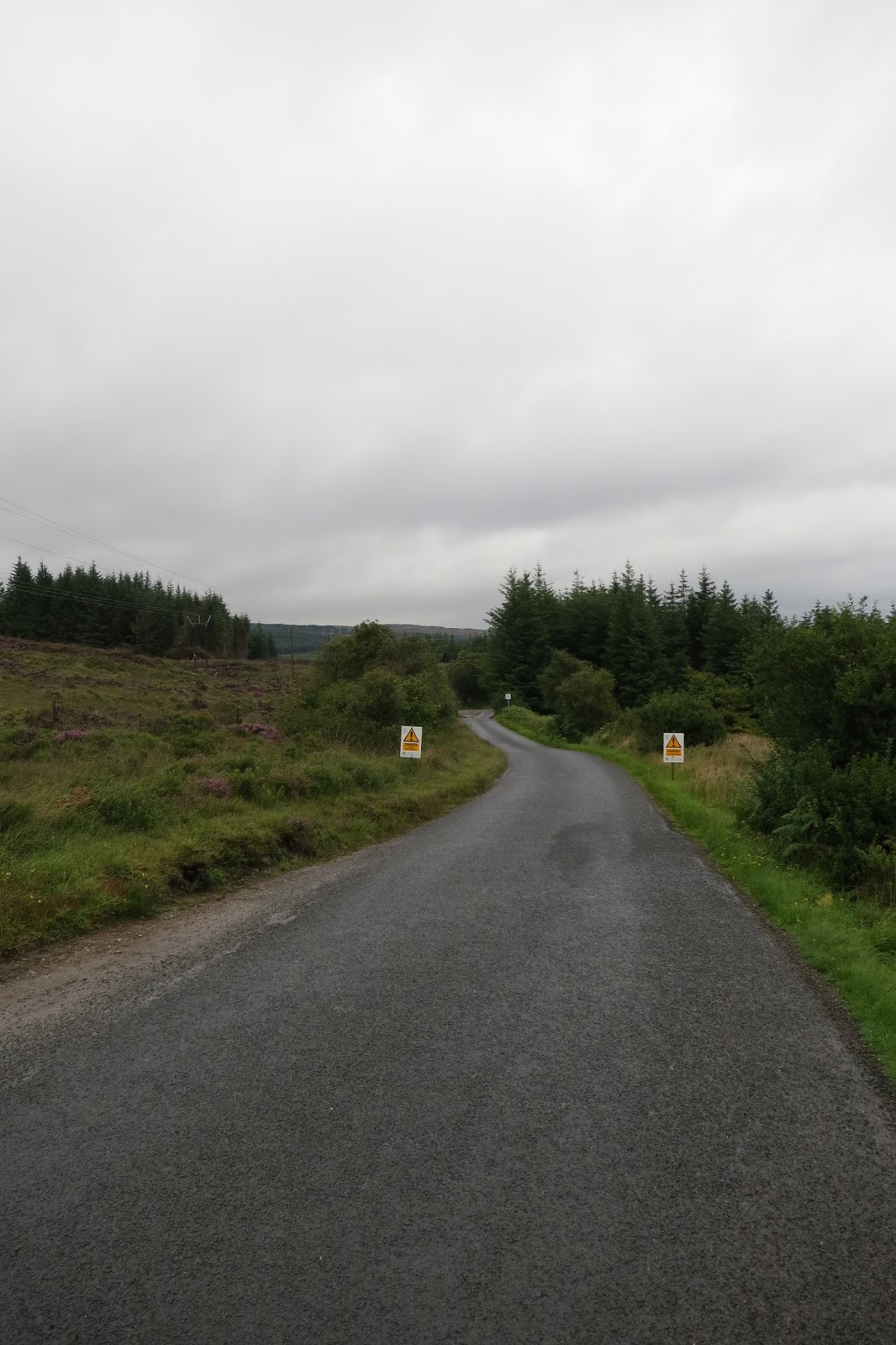
To put it mildly, the B road is almost all up and down, with sections ranging up to 14% grades. I ended up getting off my bike to walk up them and going down was a sufficiently harrowing experience with cantilever brakes and 40 pounds of gear that it's not something I would care to repeat. While the road itself was in reasonably good shape, it was single track most of the way and cars passed me on average every 5-10 minutes, which made for a lot of tricky negotiation. Thankfully almost all of them were very polite, but one never knows how it's going to go down, so it was fairly stressful. Add into this sporadic rain, which was sometimes fairly heavy, and it was not a pleasant experience.

The usual standard of pavement on the B road
There are a lot of sheep on Kintyre
The only real argument for taking the east side is that there are some great views of Arran from across the water. However, for much of the ride, the road is actually out of sight of the water, passing through forested hills and valleys.


Adding to the fun, the southern end of the peninsula is studded with headlands and bays, which, if you don't have functioning GPS, makes it all too easy to get your hopes up that the next one is the last. I got faked out a few times, such as at Penniver, which had the added bonus of a long climb out of town.

Not my final destination
To cap my ride, a soaking rain started when I was just north of Campbeltown. I was getting pretty tired and hungry by this point. I had underestimated the difficulty of the ride, as 30 flat miles wouldn't have been a big deal, but the relentless climbs had really taken it out of me. I had been doing fairly well up to that point, but I was good and bedraggled with only a few miles left to go.

Sighting Davaar Island, which sits in Campbeltown's bay
One of the few bright spots during my final push was catching a waft of whisky in the air as I rode by Glen Scotia. I got a bit lost in downtown Campbeltown, but it didn't take me too long to reorient and find Earadale B&B, where I would be staying for the next couple of nights. Jean greeted me at the door and helped me to stash my bike out back. After that I climbed the stairs to find a very snug and well appointed room.

View out of my window at the public library

The cork floor is a really nice touch
I was pleasantly surprised by the accommodations, as it was also the cheapest room I stayed in during the trip.

After a much-needed shower and change of clothes, I stumbled back outside in search of dinner. The Taj-Mahal restaurant was just around the block and Indian food sounded rather good at the time. The meal was pleasant and reasonably priced, though it was a bit too sweet and underspiced for my liking. Still, there was a delicious piece of naan that was bigger than my face, which went a long way towards making up for all the calories I had burned earlier in the day, so I wasn't too bothered.

After dinner, I wandered around the harbor to let dinner settle before I went to bed.


I continued wandering through town as the sun set, almost but not quite getting lost. Finally, I made it back to Earadale and crashed into bed. It had been a long, hard day, but Springbank beckoned...

Friday, October 4, 2013

Scotland 2013: Isle of Arran Distillery Tour

The day dawned cool and overcast, but I was ready to get an early start. Once again, I had scheduled a 10 AM tour at a distillery, though in this case it was just a 2 mile walk down one road instead of a 15 mile ride with lots of navigation.

Breakfast was the full Scottish affair, complete with haggis, which I found to be quite tasty. Castlekirk's dining room looks out over Lochranza Castle, which certainly enhanced the experience.


Pleasantly full, I strolled down the road towards the distillery. I passed by the local golf course and a lovely little burn that rolled down towards the bay. A light mist was falling, which made things damp but not uncomfortable.


I arrived at the distillery a bit before opening time, which gave me an opportunity to take lots of pictures.


No eagles in sight, unfortunately
The distillery's setting is absolutely everything you could want - craggy, green hills form a valley leading to the sea, with water flowing by from lochs and burns up above. Though I wasn't lucky enough to see them while I was there, a pair of Golden eagles live above the distillery and are often glimpsed flying in the area. As an added bonus when you're producing lots of flammable liquids, it's also right across the street from the local fire station.


I didn't have too long to wait after the visitor center's doors opened before I was ushered off on the tour by Stewart, our guide for the morning. We began with a short video, introducing the story of the distillery, which was accompanied by a dram of the excellent 14 Year.

We all trooped into Arran's stillhouse, which contains the whole production process from start to finish. All of their malt is shipped in, as the island is too wet to grow good barley. The majority is unpeated malt, with smaller amounts of peated malt (which is blended with unpeated malt to hit a 12 PPM average) and one-offs like their Bere barley project. The two very different kinds of malt require Arran to have a rotating production schedule - unpeated whisky is made for most of the year, then a small number of runs of peated spirit are made just before the quiet season when they can shut down and clean out their stills in preparation for producing unpeated spirit again.

After milling and mashing, the wort is fermented to 6-8% ABV, then piped to their wash still. At 13,000 L, each mash gives enough liquid for several charges of the 7,100 L wash still. The output of the wash still, called low wines, has an ABV of ~23% and is sent to the low wines receiver. The low wines are then charged into the smaller 4,300 L spirit still and redistilled. Three cuts are made: from 80-74% alcohol is the foreshots, which contain lighter compounds like methanol and acetone that are sent back to the low wines receiver for redistillation; 74-63.5% alcohol is the hearts, which are the potable spirit and are sent to the intermediate receiver; lastly, 63.5-26% alcohol is the feints, which contain heavier compounds like fusel oils are also sent to the low wines receiver for redistillation. Arran's tall, narrow-necked stills with flat lyne arms plus the use of condensers instead of worm tubs give lots of reflux and copper contact to produce a relatively light and grassy spirit.


At that point the spirit is filled into casks, primarily ex-bourbon and ex-sherry. Though Arran was an early and vigorous adopter of the cask-finishing trend over the last ten years, they have since backed off a bit, focusing on a small core of finishes that seem to agree with their spirit (port, sauternes, and Amarone wine). However these finishes tend to occur after the spirit has already matured in ex-bourbon casks for about eight years rather than the wine casks being filled right off the still.

The only disappointing part of the tour was that we were not able to see the inside of Arran's warehouses. Only the high end Gold Tours get to go inside and they require group reservations. As I was traveling by myself and there weren't any Gold Tours that day for me to glom onto, I was out of luck. I wanted to be able to do some cask tasting, since I really enjoyed the Arran Sherry Single Cask I reviewed last year, but it was not to be.

The tour ended in the tasting room, where we were offered samples of the Arran Gold cream liqueur. I passed on the liqueur, but did correct some impressions that I had about Arran's whiskies. The 10 Year is made from 100% ex-sherry casks, which I incorrectly thought was a mix of ex-bourbon and ex-sherry cask whisky. This is also true of their new 12 Year Cask Strength release. The 14 Year and new 16 Year releases are, however, roughly even mixtures of ex-bourbon and ex-sherry casks.

After the tour, I had lunch at the distillery - be sure to have a bite to eat if you ever visit as the food is quite tasty. Afterwards I had a round of drams (tasting notes coming later) and periodically chatted with Faye, an Arran employee I had previously talked to via email and Twitter. She was unfailing welcoming while I was at the distillery and asked a lot of questions about my trip and this blog. Being recognized in a land of strangers is no small thing.

After wrapping up my drams, I wandered back down the road and decided to explore a bit around Lochranza. I had originally hoped to ride around the island, but between the long day before and the iffy weather, a walk seemed like a safer bet.

Looking north to the mouth of the bay

Looking south towards the interior of the island
After dinner at a local hotel I decided to make an early night again, since I was looking at a lot of miles of riding the next day to get down the Kintyre Peninsula to Campbeltown.

Monday, September 30, 2013

Scotland 2013: Auchentoshan and Traveling to Arran

Trying to figure out how best to pack my panniers - a daily exercise
My first full day in Scotland... I woke up bright and early, reasonably well-rested and ready to head off into the unknown. I had two goals to accomplish: ride ~15 miles to Auchentoshan distillery for a tour, then get to Lochranza on the Isle of Arran by some combination of train, ferry, and biking.

After a smallish breakfast, I set out to get to my 10 AM tour of Auchentoshan. I had a few different options for how to get there, but went with more or less reversing course from the day before - down Byres to the river, then taking the cycle route paralleling Dumbarton until it petered out around Clydebank. At that point I more or less threw up my hands and got on Dumbarton, taking ease of navigation over the threat of cars not noticing me on a relatively busy road. I overshot the turn to Mountblow Road by a bit, but thankfully caught the mistake fairly quickly and got myself turned around. Thankfully I was able to ride the sidewalk along the A82 instead of having to get into traffic, then quickly ducked down the private road to Auchentoshan with plenty of time to spare.


The man at the gate was quite nice and promised to watch out for my bike if I propped it up by his shed. From there I wandered about the distillery buildings for a bit and eventually found my way to the visitor center.


There was a fairly large group of men waiting for a private tour, but I lucked out and there was only one other couple waiting around for the 10 AM standard tour. Rose greeted the three of us and took us off to see the Auchentoshan process. Rather than saddle you with the details, I'll point you towards Auchentoshan's very detailed website that covers most of what you'd want to know.


There are a few tidbits I can add, such as the picture right above. That middle bottle is blue for a reason - the foreshots, which contain lots of nasty chemicals like methanol and acetone, take so much copper sulfate out of the stills that it colors the liquid. You can also see it in the spirit safes as a blue-green patina around the chutes. This is why stills wear out - the copper is literally being stripped out of them molecule by molecule every time they're used.

After seeing their production process, we took a quick look through a dunnage warehouse. Auchentoshan only ages some of its spirit on site, with the rest going to the parent company Morrison Bowmore's Springburn Bond site in Glasgow, which is also where all of their whisky is bottled. A few more interesting things I learned during the tour:

Auchentoshan proofs all of their whisky with distilled water, so there's none of the "pure Highland/Island/whathaveyou water" imparting flavor directly to their non-cask strength bottles.

When their coopers rework ex-bourbon barrels into hogsheads, they put new oak heads on the casks to impart extra flavor, making an interesting hybrid of new and refill oak. This was also the first place that confirmed the fact that most sherry casks used in the whisky industry are now made custom - casks tend to be built new, seasoned with sherry destined for vingear, then emptied and shipped to Scotland. So despite all the talk of 'top-quality sherry casks' and whatnot, very few of them will have been filled with top of the line sherry. Ultimately this makes sense, since sherry bodegas are less interested in wood extraction than scotch whisky distillers. Sherry primarily gains flavor via oxidation, so the bodegas would rather use very old casks without a lot left in the wood to extract. Scotch whisky distillers want more active casks that will impart a lot of flavor to the spirit. However, this does cost a lot of money - Rose quoted a price of ~£500 for a custom sherry butt.

After our tour through the warehouse, we dropped into the tasting lounge, where Rose poured us samples of various Auchentoshan whiskies. Because we were such a small group, she actually offered to let us try whatever we wanted from the core lineup, rather than just the standard Three Wood pour. Having tried the 12, 18, and Three Wood earlier this year, I went for the 21 Year. Since I didn't have proper glassware I wasn't able to get detailed tasting notes, but my impression was that it was a bit too woody in comparison to the 18 Year that I absolutely adore. The 21 also has some sherry casks added to the mix, which didn't help when compared again the bourbon wood clarity of the 18. While a transcendent experience would have been lovely, there is something satisfying about enjoying a younger and more affordable whisky over than an older one.

After snagging a small single cask bottle of Auchentoshan at the visitor's center (haven't cracked it yet, so you'll have to wait for tasting notes), I packed my things up again and prepared to ride back into Glasgow. I took a slightly different route back after finding the Firth & Clyde Canal path, which started with the tiniest set of locks I've ever seen.


The water in the canal is almost level with the bridge, so instead of building a higher bridge they installed a set of locks to allow boats to pass underneath. While not quick, it's an ingenious solution that allowed the other infrastructure to stay in place. I continued along the path for a number of miles, until the pavement ran out and I was forced to head back onto the roads. I was saved by the Scot Guide app on my phone, as Google Maps had reset, leaving me without any other way to navigate (yes, I did have a paper map, but it was buried somewhere in my panniers). I can't recommend it enough if you're going to Scotland, as it stores maps offline and thus doesn't require cellular or WiFi service to work. After some circumlocution, I eventually made my way into the city center. Unfortunately it had taken me a lot more time than I had planned on, so I had to grab some yogurt for a quick lunch - setting a bad precedent for the rest of the trip - before navigating my way to Glasgow Central Station. There I purchased tickets to Ardrossan Harbour so I could catch a ferry to the Isle of Arran. The train ride was fairly uneventful, though I enjoyed watching the countryside slide by.

The train pulled into the last stop just in time for me to purchase tickets for the ferry and walk on board. I tied up my bike and slipped upstairs to the top deck.

Saying goodbye to the mainland for a bit
The weather was windy but dry and relatively warm, which I appreciated since I knew I had more miles to ride before the end of the day. We disembarked at Brodick, where I stocked up on a few essentials that I had forgotten and tucked into a late lunch/early dinner to refuel before I got back on my bike. The chili I had was... palatable... but then, I'm not sure how much I expected of TexMex cooking half a world away. The important part was that it was filling, so I set off with a reasonably full belly.

The opening miles of the road from Brodick to Lochranza were relatively flat and in decent shape compared to what I was expecting - everything I had read and heard suggested that island roads in Scotland tended to be a mess. The views were almost universally excellent.

The view across Brodick's harbor as the next CalMac ferry comes in

Resting in a small park a few miles along the road
The road continued to be pleasant until I reached North Glen Sannox. It was an astoundingly beautiful valley, but the road became a long and unrelenting uphill slog. Much of this was due to it being my first real day out, the fact that I had already ridden a respectable number of miles that morning, and not eating lunch at the proper time. Unfortunately this also meant that I didn't get as many pictures as I would have liked, but others have done as well or better than I could have.


The downhill descent on the other side was a little bit harrowing, as it had gotten a bit damp and it was both long and steep. Thankfully my brakes held out and it was only a little bit further to reach Lochranza. My first look across the bay was gorgeous, with the old castle standing watch over the sea.


I finally reached my destination, the Castlekirk B&B, where I found that a) I was the only person scheduled to stay there and b) the proprietor was taking off for a vacation, leaving me in her friend's hands. After being shown to my small but comfortable room, I more or less flopped over and went to sleep after such a long day.