Showing posts with label reference. Show all posts

Monday, March 9, 2015

Why Doesn't America Have Independent Bottlers Like Everywhere Else?

People who become interested in scotch will invariably discover the seeming multitude of independent bottlers who buy spirit or mature casks from any number of distilleries and bottle it (usually) with the name of the distillery prominently displayed on the label. Some are long established companies, like Gordon & Macphail or Signatory, while others are small operations that bottle a handful of casks before fading into obscurity. But with rare exceptions *cough*Glenfarclas*cough* the owners of the distilleries that they source spirit from are perfectly willing to have other companies use the names of those distilleries on their products.

The situation in America is very different. While there have always been companies that operated on roughly the same principle - buy whiskey from large distilleries and bottle it under their own labels - it is extremely rare for those labels to state exactly where the whiskey was distilled, other than the state it came from. With rare exceptions, e.g. LDI/MGP, that makes it very difficult to determine who made the whiskey in a bottle.

Until fairly recently, no one was particularly bothered by this state of affairs. But the whiskey boom of the last 5-10 years has resulted in a confluence of factors that has radically altered drinkers' attitudes. There has been a proliferation of new outfits buying whiskey from major distilleries and bottling it under their own labels at the same time as a lot of genuine new microdistilleries have been opened as a result of the increase in demand for new whiskey. On top of this, many of those drinkers are very interested in knowing exactly where the spirit they're consuming came from and how it was made.

This has, unsurprisingly, led to a lot of shifty dealing. The now classic example is Templeton rye whiskey. They were one of the first outfits to discover the untapped resource of Lawrence Distillers Indiana (LDI), which had been quietly producing a unique 95% rye mashbill whiskey. As a distillery that was already focused on selling bulk whiskey, they were perfectly happy to sell it to a new company. Templeton took that whiskey, added a story about Al Capone's favorite rye and how the recipe had been handed down over the generations, and proceeded to sell it at a very healthy markup.

It was a pretty good business plan. For a while. While plenty of customers and journalists were willing to swallow the story whole (in no small part because even some of the most knowledgeable people in whiskey didn't know about LDI when Templeton was first released), others started poking around and eventually sussed out the source. It took a while for the facts to percolate into public consciousness, but they have now resulted in a lawsuit against Templeton claiming false advertising. Similar accusations have been leveled against Whistlepig, who sourced 100% rye Canadian whiskey while giving a wink and a nod about their farm distillery in Vermont (which didn't have any stills), and Michter's, who have taken the name of a famous and now defunct distillery and used it to sell sourced whiskey.

Many other outfits, while not being intentionally shady, never state exactly where their sourced whiskey is from for the simple reason that most of the major distilleries include nondisclosure clauses in their sales contracts (though MGP no longer does). So even when a bottler would like to state the provenance of their whiskey, they are left with little to do but drop hints, rather than stating the source plainly. A few will disclose the mashbills of the whiskey they are bottling, which in some cases allows the astute drinker to suss out the source. But given how few different mash bills there are for bourbon and rye whiskey, those are often little better than guesses. This is in marked contrast to Scottish indies like Cadenhead and Alchemist who clearly the state the source of their bourbons (usually Heaven Hill).

There are a number of historical and structural reasons for the differences between independent bottlers in Scotland (and the rest of the world) and non-distiller producers (NDPs) in America. A major factor is the concentration of production in America. The vast majority of the whiskey produced in America is made by a handful of companies (Brown-Forman, Heaven Hill, Wild Turkey, Four Roses, Buffalo Trace, Jim Beam, Diageo, and MGP) at a slightly greater number of distilleries. This came about largely because of Prohibition, which both pushed a lot of distilleries out of business and, after Repeal, encouraged consolidation as the government preferred to work with a smaller number of easily regulated entities. That concentration of ownership means that each distillery produces a wide variety of brands, often from what appear to be different places. This has meant that more established NDPs have been able to happily coexist with the majors' brands as they often look very similar, e.g. Luxco's Ezra Brooks, which is distilled by Heaven Hill and has a label very reminiscent of Evan Williams or Jim Beam. Even major companies like Diageo play this game, with Bulleit bourbon being produced by Four Roses (though this is slated to change as they are opening their own distillery) and Bulleit as well as George Dickel ryes being made by MGP, while carrying a story about the Bulleit family recipe.

So when new NDPs began to blossom during the current whiskey boom, they were entering a market already replete with dubious backstories. This was also among the backdrop of microdistilleries popping up across the country, who all touted the superior quality of their 'craft' spirits. So while the majors tended to present stories based around 19th century ancestors, the smaller outfits were more likely to talk up the 'artisanal' qualities of their spirits. Many skirted around the issue without making outright lies, talking about the quality of the water used to proof down the spirit or other minor contributions, while hinting at their superior quality to justify the enhanced price tags. And let's be honest, a lot of their customers were quite satisfied with the stories they were purchasing alongside those spirits and many no doubt tasted something better than a regular bottle of Jim Beam.

Let's contrast this with Scotland. While ownership of distilleries may be nearly as concentrated (roughly the same number of majors own most of the distilleries), production is far more dispersed, with over a hundred rather than a dozen big distilleries. Even more important is the tradition of blending in Scotland, where the output of many malt distilleries, plus one or more grain distilleries, are combined to produce a single product. This necessitates the purchase and trading of casks from one distillery with others, as blenders seek the components they need to maintain a consistent flavor profile. The earliest independent bottlers grew out of the blend trade and some still have a hand in it. So there is a long tradition of warehouses containing casks of whisky from a multitude of different distilleries. It is perhaps unsurprising that some of these companies decided to start bottling some choice casks on their own, rather than making them components of blends. Because the owners of distilleries were often dependent on others for their own blends, the person you sold to today might be someone you needed to buy whisky from tomorrow. So a sort of gentleman's agreement evolved around independent bottlers, who were (usually) allowed to sell the output of other distilleries with the provenance clearly stated. That isn't to say that all NDPs in Scotland are perfectly explicit about their whisky - the blends themselves and many 'mystery malts' are just as hazy - only that in Scotland and other countries it is possible to be more explicit.

The lack of a similar blending tradition in America (it was quite novel and a little confusing when High West began to produce American whiskeys built from the output of multiple distilleries) means that there is no comparable system of trading spirits between distillers or independent companies. Sales of whiskey are largely unidirectional and primarily a matter of contracts. A distiller will sell their output when they have excess capacity and will let those contracts lapse when demand for their products rises. Additionally, the aforementioned plethora of brands produced by single distilleries means that they have an incentive to prevent NDPs from disclosing the source of their whiskey, as it would break their long-established illusions - hence the nondisclosure agreements that most NDPs are forced to sign.

At this point it would likely require a major rewriting of regulations to change the status quo. While the TTB is making an effort to enforce the labeling regulations that are on the books, these are fairly minimal when it comes to source disclosure - the state where a whiskey was distilled and the state where it was bottled are about as close as it gets right now. As I noted, the majors have no incentive to change the status quo as they aren't the ones who are hurt if customers who purchased whiskey from an NDP get mad about a brand leading them to believe that it was 'hand crafted' or any other sort of nonsense. And while it would be nice if the NDPs militated for more transparency, many of them benefit from obfuscation and those who would like to be more open have little to no leverage to bring about change. Ultimately, if customers want to know where their whiskey comes from they will have to insist upon it, either by cajoling the NDPs to disclose as much information as they are legally able to do so or by lobbying the government to change regulations to require more information on labels.

Thursday, February 28, 2013

Beginners Guide to Bourbon and Rye Whiskey

On the heels of my guide to scotch whisky, I thought I would turn to something a little bit closer to home. While rum may have launched the United States, bourbon and its cousin rye whiskey are the spirits now most closely associated with America.

American whiskey production grew out of the settlement of the Ohio River Valley. After independence, white settlers began to move west of the Appalachian Mountains, which had previously been restricted by the British government, eager to keep their colonists close to the coast where they could be more easily taxed. The farmers who grew crops in the extremely fertile region, including lots of corn, rye, and barley, found that it wasn't economically feasible to transport their grain east of the mountains where most of the demand for their products was to be found. However, if those grains were fermented and distilled, the resulting whiskey had a lot more value per pound, meaning that money could be made even after shipping it over the Appalachians. This fueled the almost insatiable appetite for liquor during the 19th century, when the average American drank about five gallons of absolute alcohol in a year (this translates to roughly one 750 mL bottle of 80-proof liquor in a week).

Column still at Wild Turkey via Alcademics
These early whiskeys would have been rather rough 'n ready, with thousands of small distilleries producing spirits from whatever grains were cheapest at the time. Most would have been using small copper pot stills and without the tools to precisely measure alcohol concentration, relying on experience and guesswork to judge when to make cuts. That meant significant amounts of unpleasant compounds from the heads and tails of a run would have made it into the hearts cut. Batch variation would have been significant - without purified yeasts to inoculate the wort and less rigorous decontamination of their equipment, wild yeasts and bacteria would often infect the mash, producing all sorts of peculiar compounds. Direct fired stills making for uneven heating of the wort, producing another set of potentially off compounds. Barrel aging would have been more often than not incidental, a product of shipment rather than planning. Which is all to say that these whiskeys would have been very different from the mellow and refined spirits we know and love today.

Now there are very tight regulations about how bourbon and rye whiskeys must be produced if the distillers want to label them as 'straight' bourbon or rye whiskey. First, bourbon must be made from a mash of between 51 and 80% corn, with the balance being made up with rye or wheat (the flavoring grain) and malted barley (the enzymes in malt convert starches from the other grains into fermentable sugars). Distillation must be to no more than 160-proof (80% alcohol) and the distillate must be diluted to no more than 125-proof (62.5% alcohol) for aging in new charred oak barrels. At that point it can be called bourbon whiskey. To gain the 'straight' moniker, the bourbon must be aged for at least two years. Bottling, whether straight bourbon or not, must be at least 80-proof (40% alcohol). American rye whiskey conforms to the same requirements, except that the mash must contain at least 51% rye, with the balance being made up with corn and malted barley.

The main axis for understanding bourbon and rye whiskey is the percentage of rye in the mash bill. Rye both adds spiciness to whiskey and covers up some of the inherent sweetness from the corn. Just outside the spectrum are wheated bourbons, which use wheat as a flavoring grain instead of rye. This makes for a much softer bourbon, without the chili pepper burn found in most rye recipe bourbons. The most well-known wheated bourbon is Maker's Mark, but I generally prefer Weller bourbons. At the beginning of the rye recipe bourbon spectrum, go for something like Buffalo Trace with 8% rye in its mash bill. Rye flavors will be present, but tend to give way to corn sweetness. In the mid range, Wild Turkey, Ezra Brooks, and Evan Williams bourbons are all made from a 13% rye mash bill and most of Jim Beam's whiskeys are made with a 15% rye mash bill. Here rye becomes a more significant presence, but is still in balance with the corn. Above this, we enter what is generally thought of as 'high rye' territory. Four Roses uses two different 'high rye' mash bills, one at 20% and another at a whopping 35% (the latter is the source for Bulleit bourbon). Jim Beam maintains a legacy 30% rye mash bill for their Old Grand Dad and Basil Hayden expressions. In those whiskeys, rye will be more more prominent, making the bourbon both more spicy and less sweet.

From there exists a bit of a gap until you hit rye whiskeys. At 51% rye in the mash bill, Jim Beam (and their Old Overholt label) Rye and Sazerac 6 Year are just over the legal line. So while these are definitely rye whiskeys, with all the spicy herbal flavors that implies, they also retains a fair amount of corn sweetness, making them a good bridge between the two styles of whiskey. From there, it's a jump to whiskeys made with 65% rye in their mash bills - Rittenhouse, Wild Turkey, and Russell's Reserve. These are very spicy and much drier than bourbon. Finally, LDI/MGP uses a 95% rye mash bill for whiskey that is now released by a wide range of independent bottlers from Bulleit to Willett to Templeton to Redemption to George Dickel (if it's a new rye whiskey brand, then it's probably from LDI/MGP - they're the only distiller with spare rye capacity). To get above that, you'll have to turn to Canada - Alberta Distillers makes a 100% rye mash bill whisky. While usually blended into Canadian whiskies, it is also sold as Alberta Premium and now bottled by a number of American independent bottlers, ranging from Jefferson's to Masterson's and Whistle Pig.

The other axis to look at is age. Because bourbon and rye are aged in new charred oak barrels, they soak up flavor very quickly. This means that even a year or two can make a significant difference in flavors. It's best to keep the mash bill of the whiskeys you're comparing the same or similar to remove that variable from the equation. Many distillers offer whiskeys from the same mash bill at different ages, such as Buffalo Trace (~4-5 years old) and Eagle Rare (10 years old) or Wild Turkey (6-8 years old) and Russell's Reserve (10 years old) or Weller Special Reserve (~7 years old) and Weller 12 Year. Older whiskeys will tend to be more oaky and tannic, but also with more caramel and toffee flavors.

While this feels like a lot of information, hopefully it gives you a few places to start or expand your exploration of American whiskeys. Bourbon and rye are fantastic choices these days because there are still so many great whiskeys available for under $30, making it a very economical way to drink well.

Wednesday, February 13, 2013

Beginner's Guide to Scotch Whisky

I'm just going to hit the highlights here. For a more in-depth beginner's guide, hop over to Malt Madness for the inside scoop.

First off, scotch whisky (always without an e) is made in Scotland. The Scotch Whisky Association fights assiduously (successfully and unsuccessfully) to prevent distillers anywhere else in the world from marketing spirits that might be confused with real scotch. So what is it supposed to be?

There are two different types of whisky that usually spring to mind when people think of scotch. Single malt whisky gets most of the adulation, with big names like Glenfiddich, Glenlivet, and Macallan. Breaking down the name, it refers to a spirit made from 100% malted (partially germinated to convert starches into sugar, then arrested with heat) barley that is fermented and distilled in a copper pot still at one distillery, then aged in oak barrels for at least three years. Even mixing in a tiny amount of another single malt will transform it into a blended malt, which is a mixture of single malts from different distilleries.

The second variety, which is what makes most of the money, is blended whisky. These include whiskies like Johnnie Walker, Dewars, and Chivas. Blended whisky is a mixture of single malt whiskies, usually from many different distilleries, that is combined with grain whisky. This produces lighter and more consistent whiskies that appeal to a broad range of drinkers. Grain whisky is simply any whisky made in Scotland with grains other than malted barley. Additionally, it is usually distilled in column stills rather than pot stills, which gives it a lighter flavor and body. As with malt whisky, grain whisky must be aged for at least three years. And most importantly to the distillers, since grain whisky is cheaper to produce, diluting malt whisky with it to make blends increases margins.

From now on I'm mostly going to focus on single malt whiskies, the superstars of the scotch whisky crowd.

From Crister Sundin
Beyond the basic requirements, there are all sorts of factors that shape the final flavor of a whisky. These range from the location of the distillery, the source of the barley, the way that it is malted (by hand or in a large malting facility), whether the germinating malt is dried with hot air or burning peat, the type of yeast used, the length of time that it is fermented, how full the still is, how quickly it is distilled, the shape (distillers will sometimes try to have every bump and dent in a still replicated when they have new ones made) and configuration of the still (does the lyne arm rise or drop? does it have a purifier?), the type of condenser, where the cuts are made (foreshots, heart, and feints), how much the raw spirit is diluted before barreling, what type of barrel is used (ex-bourbon, ex-sherry, ex-port, other spirit or wine), how many times that barrel has been used before (virgin, first fill, second fill, etc), how long the whisky is aged, where it is aged (some whisky is aged on site, while others are trucked to centralized warehouses), to how much the whisky is diluted for bottling.

Which is to say that there are a lot of different things going on, so we'll start with a few.


In my opinion, the best place to start with single malts is Glenmorangie Original. I originally picked it up on John Hansell's recommendation - he rates it as one of the best whiskies on the market today, which is no small thing given the breadth and depth of his experience. Personally, I think it's a great place to start for a number of other reasons. First, Glenmorangie uses very tall stills, which produces a fairly light spirit. This means that Original is not overly aggressive, while retaining good flavor density. Secondly, the spirit is aged entirely in ex-bourbon barrels for ten years, which both help to give it an approachable set of flavors and mean that it is uncomplicated by the various types of wine finishes available to distillers these days. It's relatively simple - there isn't a vast array of flavors to pick out of it - but what's there is very good. As an added bonus, it provides a stepping stone to investigating Glenmorangie's cask finished whiskies - these include sherry, port, and sauternes. These cask finished whiskies begin their lives in the same way as the Original, aged for ten years in ex-bourbon barrels, before being re-casked for an additional two years. This means that they are fairly comparable - they're all built on the same foundation, so you can look for differences to understand what the various casks do to the whisky. These can be picked up inexpensively either by grabbing one of Glenmorangie's Discovery packs, which includes a full bottle of the Original alongside three miniature bottles of their cask finished whiskies, or the Glenmorangie Collection, which has four 100 mL bottles of the Original and the various cask finished whiskies. Either of these should be under $40.

So where to go from that beginning? There are a number of different axes to explore.

Probably the most important is the different ways that sherry can be introduced into whisky. Sherry was historically sold by Scottish merchants who imported casks of fortified wines from the Continent to make the rough local malt whisky more palatable by aging it in the empty wine casks after selling their original contents. There are a number of different strategies for aging scotch whisky in ex-sherry casks. One, as mentioned above, is cask finishing, where whisky that was previously matured in ex-bourbon casks is transferred to ex-sherry casks to absorb some of their flavor. Glenmorangie's Lasanta is one example, along with Balvenie Doublewood. Alternatively, whisky from ex-bourbon and ex-sherry casks can be married together. This is the method distilleries like Aberlour, Bunnahabhain, Bruichladdich, and Arran use for their standard expressions. Last, but not least, whisky can be aged in ex-sherry casks from day one. This method is used by distilleries like Macallan, Glenfarclas, and GlenDronach. Any one of these would be a fine place to start your exploration.

The second major factor is peat. Both maligned and loved, peat originally found its way into scotch whisky because Scotland doesn't have enough trees. It does, however, have a lot of peat. And peat could be burned to provide the heat to arrest the germination of malted barley, preparing it for fermentation. During the 19th century, coal became more readily available, so peat slowly shifted towards being something that was used to produce a particular character in the whisky, instead of being a necessity. While peat is most closely associated with whiskies produced on the island of Islay, peated whiskies are currently being produced in almost every corner of the country. While the smoky, vegetal flavors of peat aren't to everyone's liking, there are ways to dip your toe in the pool without jumping straight to notorious heavyweights like Laphroaig or Ardbeg. A good place to start would be something like Clynelish 14 or Highland Park 12. Both start off with about 1/2 to 1/3 the amount of peaty compounds found in the Islay bruisers. This means that there is some smoke, but it doesn't overpower the other elements of the malt. Stepping up a notch, check out Springbank 10, Bowmore 12, Talisker 10 or Caol Ila 12. All of these are 'moderatedly peated', with about 50-60% of the intensity of the big boys. However, if you really want to go all out, Ardbeg 10, Laphroaig 10, BenRiach Curiositas, or Longrow CV might tickle your fancy. While the peat wars have raised the maximum, these are all still very firmly in the peaty camp, almost billowing with smoke.

Hopefully all of this hasn't been too overwhelming. There are many more features to explore, but these should give you some places to begin you're journey. It's an amazing place given that everything begins with some partially sprouted grain, but from those humble begins scotch can take on an almost infinite variety of flavors.

Sunday, December 9, 2012

Chemistry of the Cocktail Holiday Gift Guide

'Tis the season when many of you are trying to decide what presents to give your family, friends, and relatives. But what to get for those with boozy interests? Here are a few ideas.

Under $10

Lime Squeezer - if anyone you know likes making tiki drinks or other lime-intensive tipples, one of these will make their life significantly better. Juicing limes with a standard glass or plastic juicer can get rough on the wrists. The extra leverage afforded from this device makes it a snap.

Oxo Mini Angled Measuring Cup - if someone you know enjoys cocktails and doesn't already own one of these, you should definitely get them one. It blows jiggers out of the water, with just about every measurement needed up to 2 oz in an easy to view format. It also pours very cleanly, which cuts down on messes. A necessary tool for any modern home bartender.

Glencairn Whisky Glass - another must, this time for whisk(e)y drinkers. As I mentioned a few months ago, a tulip-shaped glass is necessary for anyone who wants to get the most out of their neat spirits. The glencairn is pretty much the standard and I really enjoy the set I purchased (unit cost will also go down a bit if you purchase multiples). They also look super classy, which doesn't hurt.

Under $20

El Dorado 5 Year - one of the best bargains in rums, perhaps spirits, out there. This is an excellent rum, both as a sipper and for making cocktails. A great balance between molasses sweetness and fresh fruits. This should be a hit for anyone who enjoys full-flavored rums.

•Old Grand Dad Bottled in Bond - don't be deceived by the low-rent packaging (though for a few dollars more you can get the classier-looking Old Grand Dad 114). The whiskey inside is tasty stuff. You're getting a younger version of Basil Hayden bottled at a higher proof, which means that it has a much more robust flavor. If you're really worried about the appearance, find a cheap-ish decanter and gift it that way. Anyone who likes their whiskey bold should be able to appreciate this bourbon.

Under $30

Buffalo Trace - BT's basic bourbon, but still one of their finest products. While it doesn't carry the cachet of the BTAC, it's pretty much ubiquitous and thus perfect for the times when you want to have something tasty without having to think too hard about it.

•Sazerac 6 Year Old Rye Whiskey - this is one of the best starter ryes out there. Just over the line, it still has a lot of corn sweetness, which should make it more palatable to staunch bourbon drinkers.

Beachbum Berry Remixed - if you are going to buy one book about tiki drinks, buy this one. It collects recipes from the Bum's first two books, along with updates and numerous additions. Sippin' Safari is nearly as good, though it leans more towards history, while Remixed has more recipes. If you really want to make this a great present, go to your local FedEx/UPS/whatever and get it spiral bound. The recipient will thank you for it.

Under $50

Highland Park 12 Year - this is one of the best all-around whiskies I've had so far. Sweet malt, heather, sherry, and smoke in one whisky mean that there's a little something for almost every kind of scotch drinker. The presentation is also relatively classy, just in case that matters.

Jefferson's 10 Year 100% Rye Whiskey - one of the best rye whiskeys I've had the pleasure of trying short of the annual BTAC releases. And this one is half the price, which makes it an incredible deal. Balanced sweetness, lots of rye spice and mint. A delicious experience.

Scarlet Ibis Rum - while this one is only a hair over $30, it's easily one of my favorite sipping rums and a little off the beaten path. Great balance between bittersweet molasses, mocha, and hogo. Simple presentation, but what's inside the bottle is absolutely divine.

If you have any specific questions ("My friend like X, what should I get him/her?"), I'm happy to chat about them. Just shoot me an email (bottom of the sidebar on the left). Also, check out other holiday guides from Scotch & Ice Cream, Dramming, Scotch Noob, and Sku's "What to Get" and "What Not to Get" guides.

Thursday, September 20, 2012

Does Glassware Really Make a Difference?

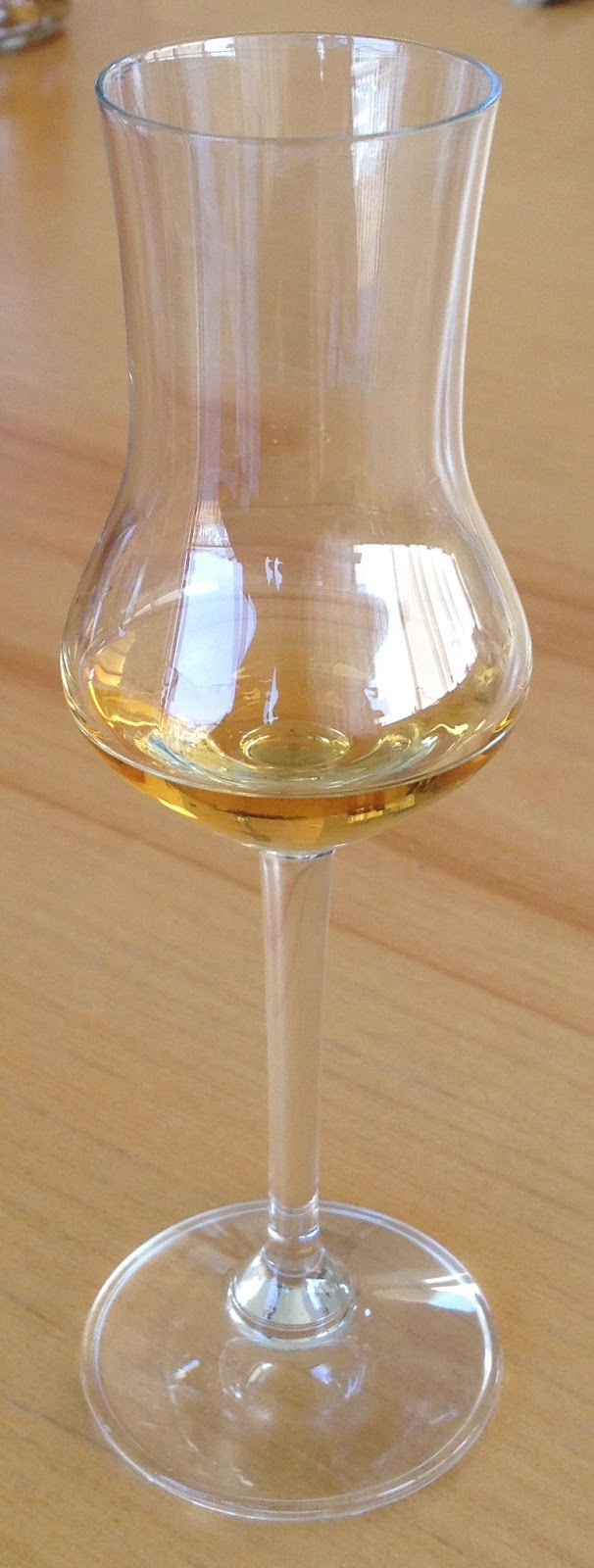
It's a debate as old as whisk(e)y connoisseurship: does the glass you're drinking out of actually make a difference in how the spirit tastes? There's a fairly solid consensus that the standard rocks glass/tumbler doesn't help much if you want to get details. The volatile compounds that make up the smells become too diffuse and it's hard to pick up specific attributes. However, there is currently a wide array of specialized glassware on the market right now which all purports to provide a better and more nuanced experience. I've managed to pick up a few things here and there and became curious to find out whether or not there were actually significant differences between them.

My procedure was fairly simple: each glass was filled with 0.5 oz of spirit, covered for a few minutes, then sampled. I tried this with two different spirits that I have previously reviewed - Eagle Rare bourbon and Glenfiddich Distiller's Edition. I sampled each spirit in its own session, trying to keep reasonably consistency each time. However, this is far from a true scientific sampling as it was impossible to do so blind and I'm sure I have some biases. However, it was still an interesting and enlightening experience.


Arran Gift Set Glass

Eagle Rare

Nose: caramel riding over mild, sweet, fresh oak, hints of berries

Taste: lightly sweet/sour up front, clarifies into creamy caramel, oak, pepper, and a hint of fruit near the finish

Glenfiddich DE

Nose: slightly dry and musty, light fruity/malt sweetness, fairly prominent alcohol, light oak, hint of chocolate and vanilla, creamy, briny, peat

Taste: very strong malt/sherry/chocolate sweetness, mild bitter/pepper at the back, slightly briny

This glass comes from the Arran 10 YO Gift Set, which I picked up earlier this year. The shape is very similar to the Glencairn tulip, which gives a significant amount of surface area for volatile compounds to evaporate, which are then concentrated by the narrower neck of the glass. It's become my standard tasting glass, especially for minis, because its ideal fill point is ~0.75 oz, which lets me get two solid tastings out of a mini.

Goodwill Angular Glass

Eagle Rare

Nose: vague caramel, little oak, more alcohol, a hint of rye grain, honey, chocolate

Taste: flatter, a little drier, more rye

Glenfiddich DE

Nose: balanced malt/fruity sherry, greenish/sour malt, a bit of chocolate

Taste: balanced malt sugar/fruity sweetness, bittersweet chocolate at the back, medium pepper

This is one of two tasting glasses I found at Goodwill a few months ago. Sadly I can't find much information about it, but it was only a dollar, so I figured I'd see how it went. Sadly I found that it didn't work particularly well, though that might not be the case with other spirits.


Goodwill Rounded Glass

Eagle Rare

Nose: pineapple, caramel, oak, subtle rye grain, bread

Taste: fairly sweet up front, then some sour oak and big pepper, mint in the finish

Glenfiddich DE

Nose: sour malt, very subdued sherry fruitiness, floral, oaky chocolate

Taste: sweetness is sherry-driven up front, great oloroso flavors, sour malt comes in mid-palate, creamy chocolate

This was another Goodwill find. Like the first, its ideal fill point is 0.5 oz. I found that this one worked better, giving a full, clear nose and palate from a rather small pour. While I'm rarely interested in such small pours, it may come in handy if I ever order dram samples from Master of Malt, which are only 30 mL. This glass would let me split them in two without feeling like I was getting an incomplete experience each time.

Vinoteque Snifter

Eagle Rare

Nose: grassier, green fruits, fresher, less caramel and oak, hints of sweet rye grain, bready

Taste: very sweet, sugary all the way through, still fresh, big pepper fades quickly, a hint of bitter oak, very subdued caramel

Glenfiddich DE

Nose: malty/floral, light but rich sherry, chocolate, subtle pepper

Taste: intense sugar/malt/fruit/sherry sweetness carries through, floral mid-palate, chocolate big pepper near the finish

This was the first proper tasting glass I ever bought and has been used in a number of my reviews. The ideal fill point is ~1 oz, which makes it a bit bigger than any of the previous glasses. The tulip shape is even more exaggerated than the Arran glass and it seems to do a very good job. I find it to be a good all-around tasting glass as it's big enough for some more extended dramming, but small enough that smaller pours aren't swallowed.

Copita

Eagle Rare

Nose: caramel-focused, a lot of alcohol, a hint of rye

Taste: sugary sweetness throughout, some musty oak and rye, a hint of chocolate

Glenfiddich DE

Nose: malty, a hint of sherry, leafy vegetables, slightly musty/dusty

Taste: brighter, more intense sweetness + lighter sherry, bitter chocolate/wood/oak and pepper near the back

This was another Goodwill find. While it's a classic design and works well for sherry, it doesn't seem to be ideal for whisk(e)y, especially in terms of the nose. Some of that may just be that it needs a heavier pour to work well, but I'm rarely drinking that much at once.


Glencairn

Eagle Rare

Nose: alcohol is prominent, light but balanced caramel, oak, and rye grain

Taste: caramel sweetness, light grain, oak, pepper, sweet/dusty near the back

Glenfiddich DE

Nose: hints of sherry and vegetal peat, very light sweetness, chocolate raisins, underlying malt

Taste: sharp acidic sweetness/sherry up front, malt, pepper, and peat further back, some chocolate

The glencairn glass is the standard for whisky tasting. It's ideal fill point is ~1.5 oz, which makes it significantly bigger than any other glass tested than the copita. It doesn't seem to work as well with small pours, so I'll stick to using it when I want a healthier dram.


While I won't draw too many firm conclusions, I'm willing to say that I think glassware does make a difference. I'd need to retest them in a random order to see if the trends are consistent, because my tastebuds may have been getting fatigued after half a dozen pours (however small they may have been).  The biggest thing I'm willing to say is that if you want to do very close examinations of taste and smell, it's worthwhile to get different sizes of tulip-shaped glasses. You want to be able to pour to the widest part of the glass for maximum surface area (especially when nosing) and its likely there will be times when you want to drink more or less at a time.

Tuesday, August 21, 2012

Where I Buy My Booze

One of the things you realize fairly quickly after becoming interested in cocktails and spirits is that it can be rather frustrating to find everything you're interested in. Almost every country on earth seems to have some maddening law that makes getting your hands on that one last piece you need for the cocktail you read about or the latest fantastic spirit release. While Oregon liquor stores have a fairly good selection for being in a pseudo-control state (and have the small advantage of being able to view almost all of the stock within the state via Oregon Liquor Search), I'm not willing to buy an entire case whenever I want to special order something.

So what are you going to do? Personally, I often turn to ordering online. Sadly liquor laws are absurd and that's not possible in every state in the U.S., but a decent chunk of the country is safe.

Here are the online liquor stores that I have personally dealt with and can vouch for having good customer service. Note, I have not received any compensation for promoting these stores, I just want to bring more business to people who have treated me well.

Hi-Time Wine - based out of Costa Mesa, CA, this was the first place I ever ordered from online. They have an enormous selection and often rather good deals. Shipping isn't too bad (at least if you're on the west coast) if you're ordering a few things at a time, usually run me $4-5 a bottle for a 4-5 item order. Service has been extremely prompt and nothing has ever been damaged in shipping, even when I ordered an entire handle of rum.

DrinkUpNY - based out of Brooklyn, NY, I was initially drawn by the fact that the store had a deal where shipping was free on orders over $100. This helped to balance out slightly higher NYC liquor prices, so I was able to get some good bargains. However, that deal is no longer in effect, so shipping prices are now the standard UPS/FedEx rates unless you live inside the city. However, I can vouch for their extremely thorough shipping methods, which more or less guaranteed that nothing was going to break. As a nice bonus, they tossed in an issue of Imbibe for free. So while I'm extremely satisfied with the service I received from them, I have a feeling that the shipping costs will wipe out any savings I could get. However, if you live on the east coast, they're probably still a good source.

The Party Source - based out of Bellevue, KY, this store is one of the few I've seen in the U.S. that regularly brings in lots of independent bottlings and its own private selection bottlings. They also have a vast selection of minis, which can be a good way to sample new spirits. They also sometimes have extremely good discounts on spirits, but you often have to act quickly as stock can be run down with surprising speed. I actually got pipped on one bottle in my last order, which must have been pulled off the shelf by someone before the staff could grab it for me. However, they did act very quickly to refund both the purchase price and the shipping costs. With all of that said, their shipping prices are, at least to me, very high. If you live closer it'll probably be a better deal, but it's difficult for me to get the price down much below $10 a bottle. Sometimes the deals are good enough that it doesn't matter, but it is a little hard for me to swallow when I can potentially get liquor from the UK shipped to me for roughly the same price. So while I heartily recommend them and have had nothing but good experiences ordering from TPS, be sure to pay attention to the shipping before you hit 'confirm' on your order.

City Wine Cellar - based out of Staten Island, Ny, I bought whisky from this store for exactly one reason. They're the only place in the U.S. I've ever seen selling any of Diageo's 3x200 mL Classic Malts packs. As the alternative was buying them from the UK, I jumped on the opportunity. As they're in NYC, shipping was definitely a bit tricky to finesse, but I was able to find enough deals to make the numbers work out. Customer service was rather good, even when I was told that they were out of one of the whiskies I had ordered. I was able to make a substitution and everything ran smoothly from there. Packing was good and they were even nice enough to include the boxes that the scotch came in, which some stores won't do without any extra fee. Overall a good experience and if you're in the NYC area, it's probably worth taking a peek. They do have some deals that would be pretty good with minimal or no shipping and also a slightly surprising variety of older Diageo releases (Rosebank 21, anybody?).

Astor Wines & Spirits - based out of Manhattan, NY, this is where my most recent order came from. While they have a great selection and some decent prices, the shipping had always deterred me. However, they currently have a deal where shipping is free for first-time customers who sign up for an online account, so I was able to get some very nice prices without having to worry about any extra costs. Admittedly, this may be the only time I ever order from them unless their standard shipping ends up being not too bad, but it's worth taking a peek around their website right now to see if the free shipping is worth it to you. Much like TPS, their shipping on my order was impeccable, with the original packaging for all of my scotch included, plus individually wrapping both the bottles and boxes. Overall a very good experience.

There are also a number if stores that I've had my eye on, but haven't purchased from before. I'd love to hear whether any of you have dealt with them before and what your experiences were like.

Ludwig's Fine Wine - located north of San Francisco in San Anselmo, CA

Riverside Wine Merchants - located just outside of NYC in North Bergen, NJ

Master of Malt - located in Royal Tunbridge Wells, UK, MoM is famous among scotch aficionados, especially for their Drinks by the Dram sample program. I'm particularly interested in them because of their reasonable shipping rates.

The Whisky Exchange - located in London, UK, TWE has quite a number of the 3x200 mL Classic Malts packs that I covet, as well as one from Bowmore. Shipping prices seem to be a little high, but I might be able to justify an order.

Are there any other stores you've had good experiences with? Let me know in the comments or on Twitter as I'm always on the lookout for new places that might have good deals or items I can't get elsewhere.