Showing posts with label Longrow. Show all posts

Friday, January 11, 2019

Whisky Review: Longrow Peated

Much like Hazelburn, Longrow has had an unstable lineup in recent years. There was a period when it had a full range consisting of the NAS CV, plus aged dated 10, 14, and 18 Year expressions. More recently that has collapsed down to the NAS Peated expression, the annual wine cask Red releases, and the older 18 Year, with nothing holding down the middle of the range. Hopefully this is a temporary state of affairs as the distillery rebuilds stocks, but only time will tell.

This whisky was aged entirely in ex-bourbon casks, then bottled at 46% without coloring or chill filtration.

I purchased this sample from Whiskysite.nl

From Springbank Distillery
Longrow Peated

Nose: minty toothpaste, fresh malt, mellow peat and hay, leathery oak, buttery. After adding a few drops of water it becomes softer and the peat becomes ashier, but the overall profile stays the same.

Taste: lots of bourbon cask sweetness up front, turning bittersweet with mild oak, peat, and some vaguely fruity top notes from the middle back. After dilution the peat gets stronger and moves forward but remains fairly mellow overall, while the sweetness gains a floral edge.

Finish: light balanced peat, oak, and malt sweetness

I first tried this whisky at a tasting event a few years ago, not long after it was first released. That was also not too long after I had tried the CV expression and found it to be one of my favorite Longrows. So I was extremely disappointed to find that the newer Peated version just seemed tepid in comparison. But I chalked that up to it being the first version and hoped that it would improve in subsequent releases.

So I'm very sad to say that it still doesn't do anything for me. This has nothing of the waves of vegetal peat and TCP I found in the CV, leaving a relatively mild whisky with little to distinguish it. There doesn't even seem to be that much peat, belying both its name and the fact that the components are presumably not particularly old.

This is rather unfortunate as the eye-watering price tag of Longrow 18 Year means that this is likely to be the first and possibly only introduction people get to Springbank's heavily peated malt. As is, I'm glad to have a few other Longrows tucked away to keep me company, because this one will not be joining them.

Thursday, April 26, 2018

Whisky Review: Longrow Red 12 Year Pinot Noir Cask Finish

Continuing the Longrow Red series, this was released in 2015 and returned to the red wine finishes after the atypical port cask release of 2014.

This whisky was aged in bourbon barrels for 11 years then finished in fresh Pinot Noir casks for an additional year, then bottled at 52.9% without coloring or chill filtration in an outturn of 9000 bottles.

Longrow Red 12 Year Pinot Noir Cask Finish

Nose: balanced savory peat smoke and wine, floral, bubblegum, vanilla, banana? After adding a few drops of water it becomes more savory with a hint of cured meat, the peat and wine are softer and more integrated, and the malt is creamier.

Taste: wine and malt sweetness up front, gentle oak and off-dry wine in the middle, a little heat and a bump of dry malt with background peat smoke before the finish, plus more wine at the back. After dilution it becomes softer and sweeter up front, the wine is more integrated, and the peat folds into the stronger oak at the back with creamy malt undertones.

Finish: wine residue, light oak, and a touch of peat smoke

The wine in this release reads more like a fortified wine than a red wine. While some of it may be because the bottle has been open for quite a while, it comes off as simpler and far softer than the Cabernet Sauvignon with some compensation in stronger and more savory peat at full strength. Overall I liked this, especially as I think I would have gone through the bottle more easily than the Cab. With that said I don't think I'd be willing to pay the $110+ that the remaining bottles in the States appear to be going for.

Monday, April 23, 2018

Whisky Review: Longrow Red 11 Year Cabernet Sauvignon Cask

Longrow Red is a series of heavily peated, full strength, wine cask finished whiskies that has been coming out since 2012. While most have been red wines, there have been exceptions such as a port cask finish. Importantly, unlike many finished whiskies, these are closer to double maturations in that the finishing periods range from 1-5 years.

This whisky was aged in refill ex-bourbon hogsheads for 7 years, transferred to fresh Cabernet Sauvignon hogsheads for 4 years, then blended to give an outturn of 9000 bottles at 52.1% ABV without coloring or chill filtration.

Longrow Red 11 Year Cabernet Sauvignon Cask

Nose: gobs of fresh malt, slightly sour wine, dry peat smoke, fresh vegetation, dried lavender, cinnamon bark, mild oak, savory/yeast undertones. After adding a few drops of water it becomes softer with more savory malt, the wine fades significantly behind dry oak and peat, and the lavender remains a solid thread behind everything.

Taste: fairly hot up front with sour & sour wine on top, creamy malt underneath, fade out through oak/wine tannins and dry peat, gently floral at the back. After dilution the heat fades significantly, but the structure remains overall the same except for a bump of extra sourness at the back.

Finish: oak tannins, red wine, a thread of peat smoke and dried lavender

While a little on the hot side, this is a very solid whisky. I wish the wine influence was more integrated, but the finishing period seems to have been long enough to keep it from feeling like something slapped on top of the spirit. The nose is by far the best part, with a good balance between intensity and complexity, especially after it's had some time to breathe in the glass. In contrast the flavors are a little less exciting, without any particular complexity.

Diluted to 50%

Nose: light dry peat with a sour edge like hard apple cider, lots of berries, red wine, oak with a little wood smoke

Taste: sweet malt and red wine up front, a citric tang right behind transitioning into moderate oak tannins, vanilla, and hard apple cider in the middle, with a bump of peat near the back

Finish: peat, oak tannins, red wine residue, berries

While there's nothing wrong with this strength, it's a sort of unsatisfying middle. It doesn't have the intensity of full strength, but also doesn't have the extra peat that emerges with even more dilution. Additionally, the sourness in the aromas somehow seems even more assertive than at full strength, which makes it less pleasant than it would otherwise be. With that said, the hard apple cider character that emerged after the whisky had been in the glass for a while was really interesting.

Diluted to 45%

Nose: lots of classic Longrow peat, woodsy/pine, rather dry - more savory than sweet, red wine underneath with some ripe tomato notes, clean malt and oak in the background, a little bit of vanilla

Taste: balanced malt and red wine sweetness up front, becomes more savory with tomato notes in the middle, peat and syrupy oak at the back, and vanilla and berries on top throughout

Finish: dry peat, mild oak, a little red wine residue

While dilution takes away most of the heat, it doesn't diminish the intensity of this whisky. It was a pleasant surprise to find out how much stronger the peat is at this strength, even if it loses a little bit of complexity. I think I prefer it at full strength, but it would be quite welcome at 46% when I'm looking for something more easy-going.

Monday, December 14, 2015

Whisky Review: Longrow 10 Year 100 Proof US Release

Springbank has released two different versions of Longrow 10 Year 100 Proof - one for the UK at 57% (100 British proof) and one at 50% (100 American proof). The American version first showed up in the US in 2008 but has since been discontinued (as with most of the age-dated Longrow lineup). Unlike the standard Longrow 10 Year at 46%, which is a mix of ex-bourbon and ex-sherry casks, Longrow 10 Year 100 Proof is entirely from ex-bourbon casks.

Longrow 10 Year 100 Proof

Nose: new make spirit and pine, damp peat smoke and wood ash, fresh oak, pickle juice, green malt, lightly floral, plastic, peaches, savory orange peel, mint, bubblegum. After adding a few drops of water the malt becomes cleaner and sweeter, integrating with the floral and bubblegum notes, the cask influence ramps up with some vanilla coming out.

Taste: malt and cask sweetness up front with light floral/lavender notes, transitioning through vanilla and green vegetal/new make/pickle juice flavors starting in the middle, light fresh oak/caramel and more floral notes near the back, a touch of fresh peat rides through it all in the background. After dilution the sweetness expands and covers up the new make character until the very back, the oak expands to give it a little bit greater sense of maturity and a peppery quality, and unripe fruit (apples, pears, berries) comes out.

Finish: pineapple, a little sour, green malt, distant peat, floral, mint, black pepper, soapy

This whisky honestly feels kind of underdone and not what I would expect from a Longrow. I'm guessing all of the casks were refill because the wood impact is very minimal and has done little to diminish the new make character of the spirit. Some of that clears after fifteen minutes or so in the glass, but it's still not what I expected before opening the bottle. I had hoped for something akin to Ledaig 10 Year - a bold whisky with big peat flavor tenuously balanced by bourbon cask influence. Instead it feels like a bunch of weak casks that had lost their peat too quickly were tossed together - this seems even less peated than Springbank 10 Year. Especially given that the remaining bottles in the US are going for close to $100, I can't really recommend it other than for the sake of curiosity. If you're going to buy a discontinued Longrow, make it the CV.

For a different but no more complimentary review from the same bottle, check out Michael Kravitz's post.

Wednesday, October 16, 2013

Scotland 2013: Springbank, Glengyle, and Crosshill Loch

I once again woke up bright and early, because I had a 10 AM tour of Springbank and Glengyle scheduled. Breakfast was another full Scottish affair, which was good since this tour promised to involve more walking than usual. David and Jean were also extremely accommodating when I asked if I could get breakfast at 6 AM the next morning, as I needed to catch the 9:45 AM ferry from Kennacraig to Port Ellen - the next one didn't run until the evening, so I didn't want to miss the morning run.


The weather that Saturday was, to put it mildly, gorgeous. Partially cloudy skies with a bit of a breeze kept things pleasantly cool. I poked around town for a bit until wandering over to Springbank, where George greeted me at the front gate. A handful of other guys joined us for the tour, which started in the malt barn.


Springbank the only distillery in Scotland that produces 100% of its malt on site - other distilleries with their own malting facilities use at least some commercial malt as well. Water for the malting process, as well as everything else in the distillery, is obtained from the Crosshill Loch, located behind the town. Malt is brought in, soaked with water from the loch, then piled 4-6 inches on the floor. One peculiar feature of Springbank's maltings is that temperature regulation is provided only by windows - this means that very careful attention must be paid to ensure that the malt doesn't get too warm while it germinates. All of the turning is done by hand - the first, but far from the last, element of their production process that is done by hand. However, the distillery was in its quiet season, so we didn't get to the see the malting in process. Instead, the space was being cleaned out so that it could be used as a gallery for local artists - one small example of how the distillery seeks to support its community.

From there we moved on to the area where they dry their malt to halt germination. Springbank is also unique in that they regularly use three different varieties of malt to produce three different kinds of whisky - Hazelburn is made from unpeated malt, which is dried over 20 hours with what George described as an enormous hair drier, Springbank, which is smoked for 6 hours with peat and an additional 24 hours with hot air to give ~10 PPM phenols in the malt, and Longrow, which is smoked for up to 48 hours (this is an extremely long time, I later found out from visiting other distilleries with maltings) to give ~50 PPM phenols in the malt.
The extremely complex peat storage facilities
The kiln used for peating malt
The 'giant hair drier'
A view from the flue underneath the kiln floor, with lots of peat residue
From there we passed through the large malt bins to the mill. We finally hit trend status - this was the third distillery I visited with a Porteus mill for grinding their malt. I later learned that there was a good reason for this - some of the mills were nearly a century old, so there was no reason to buy an inferior product. However, this wasn't so good for the company that built them - Porteus went bankrupt some years ago. The mill grinds their malt between two sets of rollers to give a mixture of husks, grist (think grits), and flour. The mixture has to be just right - if the percentage of husks is too low then too much material will flow through after mashing and if the percentage of flour is too high then the mash tends to become sticky and difficult to work with.

The next stop was the distillery's (in)famous open-top, cast iron mash tun, one of the last in the industry.  They use for waters in their mash, with increasing temperatures each time. The first two extract most of the sugars and are combined and pumped into a washback for fermentation. The third and forth waters pull out the last bits of sugar from the malt and are then recycled as the next mash's first and second waters, respectively.


Don't fall in
After a quick peek inside to see the wicked-looking rakes, we went next door to the washbacks. These are built from Scandinavian boatskin larch and last about fifty years before they start leaking too much to be useable. Even though we didn't get to see any fermentation in progress, it was still interesting to note the microbial scum floating on the water used to keep the wooden washbacks from leaking - there are plenty of bugs living on and in the wood.


There's an ongoing debate in the industry whether those microbes play any part in the flavor of the whisky, as some distilleries replace wooden washbacks with stainless steel. Presumably most of those microbes will be out-competed by the yeast added to the wash for fermentation, but at least some of them are likely to be multiplying and kicking out various compounds that add nuance to the wash and the subsequent whisky.

Springbank uses very slow-acting yeast for their fermentations, which take 72-100 hours to reach 4.5-5% ABV. This is very much the 'slow and low' approach to fermentation - it is ~50% longer than most distilleries and about half the ABV. While this reduces the yield per unit of malt, it also means that more secondary flavors are created alongside the alcohol. As an upside, the slow fermentation means that they don't need 'switchers' to prevent the wash from bubbling over the top of the washbacks.

After fermentation, the wash is pumped over to the stills. There are a number of features of Springbank's stills that are rare in the industry. First, their wash still is direct-fired (though it also has the now standard steam coils) with an oil burner underneath. This means that the still also needs a rummager - essentially large copper chains on arms that sweep the inside of the still to prevent any residual solids in the wash from burning and sticking to the inside of the still. Direct firing may contribute to the character of Springbank's whisky, because the higher heat of an oil burner produces compounds not produced by the more even heat of a steam coil. Steam gives more consistency, but direct firing produces more complexity.


I will defer to Springbank's own diagrams to explain the triple, partial triple, and double distillation procedures that are used to produce Hazelburn, Springbank, and Longrow whiskies. The production schedule - Hazelburn first, then Springbank, and finishing with Longrow - ensures that there is no cross-contamination of their spirits with one another. The phenolic compounds in peat tend to be tenacious, so very thorough cleaning of the equipment is necessary to make sure that none of it ends up in Hazelburn.

We exited the stillroom and went to the filling station, where barrels are weighed, filled with new make, then weighed again and marked, so that the rate of evaporation can be checked down the road.

We also got to take a look inside both traditional dunnage and newer rack warehouses. Dunnage has the advantage of consistency - casks are stacked at most three high and the earth floors keep temperatures cool in the summer and warmer in the winter. The downside is that because of the way the barrels are stacked, checking one somewhere in the middle is a huge physical task. Rack warehouses go up between five and seven levels, which means that there is a larger temperature gradient between the bottom and the top of the racks. On the plus side, checking individual casks is a comparatively easy task as each can be popped out of its slot.


Fun note, I noticed a few casks of 90s Ardbeg sitting in the warehouses (I'm sure they were positioned there for a reason, but hey). Bet those will fetch a pretty penny when Cadenhead's finally gets around to bottling them.


The last part of Springbank we visited was their bottling hall. Once again, the sheer amount of work necessary to put out their whisky became glaringly apparent. Casks have to be rolled in and dumped in a marrying vat, which also limits how much whisky they can bottle at a time. Cases are stapled by hand. The whisky has to be filtered (but not chill filtered). Bottles have to be checked for flaws, filled, labeled, corked, and topped with foil. While there are machines for a few of these processes, they're not automated - someone still has to stand in front and move things along.

This is a huge part of why Springbank employes so many more people than the average distillery - everything is done on site and all of it requires a lot of hands. It is another way in which the distillery tries to support the Campbeltown, by creating jobs that keep more of the money in the community, compared to having their whisky transported in bulk for bottling at an automated plant. This definitely adds to the premium that Springbank whiskies command, but it definitely makes me a lot more sympathetic to the distillery. In an industry dominated by large conglomerates that often extract a lot of value out of the area around distilleries while imposing significant costs (wear on roads being a major one) and not giving a lot back, Springbank is a noticeable exception.

That tape bucket is full of the foil caps added on every bottle


That wrapped up our tour of Springbank, but there was more to come. Everyone trooped back out into the sun to walk down Glebe Street, formerly the site of a number of Campbeltown distilleries, to the recently refurbished Glengyle distillery.

The original distillery was founded in 1872 by William Mitchell, brother of John Mitchell, the co-founder of Springbank. The two had a falling out, which resulted in William starting his own distillery. However, the business had collapsed by the mid-20th century and fell into disrepair, being used for everything from a rifle range to a carpark over the intervening years.

In the late 1990s, the Scotch Whisky Association began to rumble about delisting Campbeltown as a distinct whisky region, because there were only two remaining distilleries in the town - Springbank and Glen Scotia. Something needed to be done.

The Glengyle buildings were purchased by the owner of Springbank, Hedley Wright, a descendent of the original owners, in 2000. It took four years to fix everything up and install new equipment, including stills salvaged from the defunct Ben Wyvis distillery.


While the goal is to eventually have Glengyle be self-sufficient in the same way that Springbank is, with the whole production process being carried out on site, it is still dependent on Springbank for malt (six hours of peat, 30 hours of hot air to give ~15 PPM in the malt) and bottling.

Much like Arran, the milling (done with a mill obtained from the Craigellachie distillery), mashing, fermentation, and distillation are all sited on a single floor.

Wooden washbacks

The stainless steel mashtun

Fermentation and distillation is similar to that of Springbank, with long fermentation times, low ABV wort, and double distillation carried out in roughly the same way as Longrow. This results in a spirit that is similar to, but still distinct from, the three produced by Springbank. As an interesting note, the stills were modified from their original shape and riveted construction to the new shape and soldered construction they now possess.
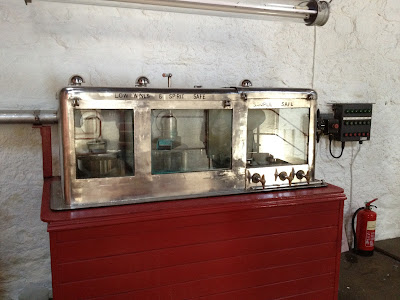

I love the 1950s American diner style of the Glengyle spirit safe
We popped around the back to see the inspiration for the logo of Glengyle's whisky, Kilkerran. The Glengyle name is currently owned by Loch Lomond and used for one of their blended whiskies, so the distillery can't release its whisky under that name. The steeple of a local church is within sight of the distillery and the peak is framed by a small hole in their wall.

From the distillery we walked back down Longrow to the Cadenhead's shop. We trooped into the back to taste a number of different whiskies from Springbank and Glengyle. Standouts included the Kilkerran WIP5 Sherry Cask (the Bourbon Cask was somewhat unremarkable) and Longrow Red. We also tried some of the Cadenhead's living casks, which are casks that are regularly topped up with their respective whiskies whenever they drop below half full or so. This means that almost every time you go back they will taste different as new whisky is added to top them off.
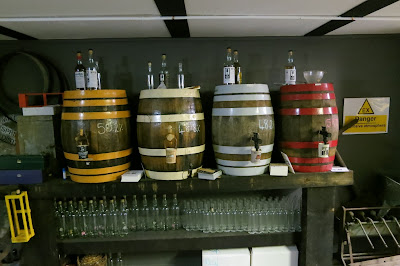

There was also a locked cage containing Cadenhead's 'Duty Paid' samples, which are single bottles from casks that will never be bottled on their own again. This includes fairly standard casks as well as weird one offs like Demerara rum. The upside/downside of this is that there is no way to know what the bottle will be like - no one else has ever tasted it before. Still, it took a supreme act of will not to buy something out of there, but the knowledge that I was at the beginning of my trip and would have to carry anything I purchased around for the rest of my time in Scotland helped. I settled for 200 mL bottles from the Hazelburn living cask and the Campbeltown cask, which is a blend of Hazelburn, Springbank, and Longrow.

A case of wonders
After departing Cadenhead's, I walked around the bay to Glen Scotia, in hopes of getting a tour. Sadly by the time I got there, the one employee who had been present that day had just left after giving a small group of people a tour. So it goes - Glen Scotia is a working distillery, I was there on a Saturday, and they don't have an organized system for giving tours. I was really disappointed after trying their whiskies earlier this year, but it was a sunny day and I had a full afternoon, so I headed back into town to grab some lunch.

The closest I got to the distillery

After refueling, I decided to go for a walk around Crosshill Loch, roughly following this route. I took a slightly more circuitous course through town, but eventually managed to find the path towards the loch, which skirted a number of farms. I walked around the west end of the loch, then headed east and back down towards the bay along the Kilkerran Burn. I ended up at a large cemetery and eventually found the road, which took me north and back into town. It would have been nice to properly hike up Beinn Guilean, but I knew I had an early day coming up and would be working plenty hard to get myself to Islay.

Looking back into town - the church spire is just visible in the middle


Looking south towards Beinn Guilean

Crosshill Loch from the west end

Looking out across the bay towards Davaar Island


The east end of the Loch
After getting back, I more or less crashed, beyond getting dinner. I knew I needed to get up before 6 AM, so I could finish packing, eat breakfast, then get on the road towards Kennacraig. It was going to be a long haul.

Wednesday, June 12, 2013

Whisky Review: Longrow 14 Year

I've covered some of the younger Longrow single malts before, namely the CV and 10 Year releases. This the first one that I have a full bottle of, so it's been nice to go through pretty much the whole thing before forming a final opinion. As with all Longrows, this whisky is made from heavily peated (~50 PPM) barley. It spends its whole life in ex-sherry casks (though I have seen other statements that it's a blend of bourbon and sherry casks or bourbon cask whisky finished in sherry casks - but this may just be different releases), putting another layer on top of the usual Springbank malt and salt.

Longrow 14 Year

Nose: very sweet, juicy berries, light sherry influence, fresh floral malt, caramel, vanilla, subdued vegetal/grassy peat, smoldering logs, bacon, seaweed, maritime air, mineral notes. After adding some water, the focus shifts towards the malt and peat, with the sherry moving back a bit.

Taste: sweet and rounded sherried malt with just a hint of sourness and bitterness up front, slowly wending its way into a pool of vegetal peat, black pepper and oak. After dilution the palate becomes much more malty sweet, with more creaminess and the sherry retreating.

Finish: very mild peat, black pepper, creamy malt, sherry, a hint of salt

I will give the same caveat that I give for most Longrows - don't expect a big Islay smoke bomb here. Especially on the nose, the peat isn't going to beat you over the head with phenols. It's spice rather than the main course. With that said, I really like the interplay of sherry and peat in this whisky. While initially sweet, especially on the nose, it has excellent balance. This is head and shoulders above the 10 Year I reviewed a while back. It's a much more cohesive expression of what Longrow can be. The sherry gives it more weight, but doesn't go so far as to smother the malt. And despite the extra years, it still seems very fresh and there's actually more pronounced peat than in the 10 Year (though that may have been a function of the sample I had). Overall Longrow 14 Year is a very, very enjoyable whisky. And while it's generally overpriced in the US ($100+), it can usually be purchased at much more reasonable rates from the UK, e.g. Master of Malt and The Whisky Exchange (I accidentally bought a bottle from each of them due to different naming conventions).

Because I happened to have some on hand, I was curious to see how the 14 Year compared to one of its younger brethren. Longrow CV is noticeably less mature - the malt and peat nearly jump out of the glass and have that bright agricultural character you get before the barrel really leaves its mark (e.g. Kilchoman). There are still a few feint-y notes from lighter compounds that haven't had enough time to evaporate or be transformed into something else, but it gives the whisky a pleasant edge. It's very green and vegetal rather than smoky, which makes me think of open fields rather than fire and ash. That wonderful Springbank saltiness is still there, which provides such a delicious accent to the other flavors. With time some oak tannins and meaty notes emerge to give the spirit a little more weight, but the focus is always on the inputs - malt and peat. The various finished whiskies that went into making this expresion will peek out, but are more bit players than stars of the show. What's nice is that the shared lineage between these two whiskies is clear but the emphasis is different. The 14 Year is more august, but the CV has youth and vitality behind it. Which I enjoy more really depends on my mood.

Wednesday, December 12, 2012

Whisky Review: Longrow 10 Year Old

Thanks again to my reader Florin for sending me a sample of this whisky.

I tried Longrow CV earlier this year. The robust peatiness took a little while to warm up to, but eventually I crowned it the winner among Springbank's CV range. With that under my belt, I was really interested to try one of the age-dated Longrows.

Longrow is the second style of Springbank's whiskies, with production beginning in 1973. It is a heavily peated (~55 PPM in the malted barley), doubled-distilled whisky. Those characteristics mean that it shares much in common with the whiskies made on the island of Islay, a bit northwest of the Kintyre peninsula where Springbank is located. This is entirely intentional, as the chairman of Springbank at the time wanted to see if it was possible to produce an Islay-style whisky outside of the island. It took several more decades until Longrow became a regular part of their production in the early 1990s, but it now has a fairly regular range of age-dated expressions. However, Longrow is still a niche even within Springbank, taking up ~10% of their production. Like Hazelburn, Springbank's other style, Longrow is named after a now-shuttered distillery in Campbeltown.

Longrow 10 Year Old

Nose: very delicate, vegetal peat - almost like incense, a hint of pine, slightly sour, citrus, vanilla, malty, toffee, bread-y salt, a few fruity/sherry notes, fairly dry, chocolate. After adding a few drops of water, the nose becomes even more mild, the peat becomes greener and almost grassy, and the toffee becomes more present.

Taste: sour citrus and berries (makes me think of Oregon-grape), malty sweetness, toffee, chocolate, a touch of pepper, and mild peat at the back. After adding a few drops of water, the sourness become more recognizably lemony.

Finish: toffee, chocolate, light peat and pepper.

The first time I took a sniff of this whisky, all I could think was "Where did the peat go?". Longrow 10 is made from ex-bourbon and ex-sherry cask whiskies that are aged only a few years more than most of what goes into Longrow CV (there is some teenaged whisky in that expression, but probably not too much). Sure, there is also probably some 11-13 year old whisky in the 10 year old as well, but it's still not a huge difference in age. Yet the peat reek had been almost entirely washed away. In a lot of ways I think this actually makes it a more pleasant sipper - the peat is an accent on the malty flavors of toffee and chocolate. However, I did find myself wishing for something a bit more assertive. Admittedly, this may be a side-effect of tasting a sample rather than a fresh bottle, but other reviews suggest that Longrows quickly head in that direction as they get older - the 14 year old is supposed to be even more diminished (I'll find out for myself soon enough) and the 18 year old is downright tame. This is really, really surprising, both because of the heavy peat character in the CV expression and because the phenol concentration in the Longrow malt is about 50% higher than that of the malt used to make very peaty whiskies like Caol Ila and Lagavulin. There's something about the way Springbank ages their whiskies that causes the peat reek to diminish exponentially with time. It's not precisely a bad thing, but you have to properly calibrate your expectations. If you're looking for something Islay-style, this is going to be more of a Bowmore than a Laphroaig or Port Charlotte.

Wednesday, May 16, 2012

Whisky Review: Campbeltown Gift Set

This is a set of 200 mL bottles containing the CV (Curriculum Vitae or Chairman's Vat, no one seems to be sure) expressions of Hazelburn, Springbank and Longrow whiskies from the Springbank distillery in Campbeltown.


Springbank is unique among scotch whisky distilleries in that the entire operation - from floor maltings to distilling to aging and bottling - is carried out on site. The ability to make their own malt is key to their three whiskies. Hazelburn is produced from unpeated malt, Springbank is made from lightly peated (~10 PPM) malt and Longrow is made from heavily peated (~55 PPM) malt. Additionally, each whisky is distilled in a slightly different fashion. Hazelburn is triple distilled, Springbank is distilled two and a half times (two full distillations, then part of the double distilled whisky plus the leftover feints from previous second and third distillations is distilled again), and Longrow is double distilled. For some neat diagrams that detail exactly how each whisky is distilled, check out the 'distillation process' tab on Springbank's page for each whisky. I really appreciate the distillery being so open about their process, as details like these help to build an understanding of the influences on each whisky.

Both the malting and distilling methods contribute strongly to the character of these whiskies, which lets Springbank produce almost any style of whisky imaginable. Hazelburn, with its unpeated malt and triple distillation, shares much in common with Lowland whiskies. Longrow, with its heavily peated malt and double distillation, is almost a dead-ringer for an Islay single malt. However all of the whiskies retain a distinctly Springbank character, largely in the briny flavors that can be found across the range. Another feature of the distillery's products is that they are all bottled at a minimum of 46% and without chill filtration, which helps to give all of the whiskies good heft and body.

The CV bottlings of Springbank's three whiskies are a way to deal with the fact that the distillery currently has large amounts of younger whisky and older whisky, but less of the 10-14 year old whiskies that usually go into standard age statement whiskies. So the CV editions contain mixes of whiskies that are roughly 6-14 years old. While the exact proportions remain a secret, it's safe to assume that the preponderance is going to be whisky on the younger end of the spectrum with a bit of older whisky to add some complexity. Additionally the whisky in these expressions has been aged in a number of different casks that previously held bourbon, sherry, port and rum. Again, it seems safe to assume that ex-bourbon cask whisky will make up the bulk of what goes into these whiskies, with smaller amounts of other cask finished whiskies added for complexity.

Hazelburn CV


Nose: briny malt, a hint of brown sugar over oatmeal, honey, corn, green apples, pencil shavings, earthy, barbecue, vinegar, seaweed, a bit of fruitiness. After adding a couple of drops of water, it gets a bit more fruit, creamy grain, vanilla, wood smoke, and some vegetal peat

Taste: malty sweetness tinged with sourness, brine, wood spices, pepper, a touch of sherry just before charred bitter oak near the back. After dilution it becomes sweeter up front, with less sourness and a hint of chocolate mid-palate

Finish: long, carries through the same flavors as the palate - brine, bittersweet cacao, oak and a bit of lingering peat. It gains a bit of vegetal peat after dilution

Hazelburn CV is made from whiskies that are 6-10 years old, which are mostly aged in ex-bourbon casks and a smaller amount comes from sherry casks. As I noted, Hazelburn shares many similarities with Lowland whiskies, both in terms of production and the flavors of the whisky. And compared to either Glenkinchie 12 or the Auchentoshan 12 I tried last year, this is significantly more robust. The bottling proof and lack of chill filtration definitely help to beef up the final product. Hazelburn clearly enunciates Springbank's character, without any peat to mask it. The briny notes make for a nice counterpoint for the lighter flavors of this whisky, making it much more interesting than a lot of Lowland or Irish malt whiskies. In some respects, it reminds me a bit of a younger wheated bourbon, like Weller Antique, with the very grainy nose and fairly sweet palate, but without quite so much caramel and vanilla. With that said, this whisky feels slightly unbalanced, especially on the palate - I've got to wonder if they combined younger malts with older casks that have gotten a bit too woody and hoped that it would come out somewhere in the middle. If so, I don't think they've quite hit the mark. So while I'm glad to have tried it, I'm also glad that I only got a 200 mL bottle. Every once in a while it will really tickle my fancy, but it's not selling me on the much more expensive 8- or 12-year old Hazelburns.

Springbank CV


Nose: sweet peated malt, a bit smoky, rubber, light burnt sugar, a touch of TCP, and vanilla. After adding a couple of drops of water it becomes softer with more creamy malt, a bit less peat, but with other vegetal and herbaceous notes, cinnamon, baking spices, rum, bourbon, a hint of sherry and fruit, and a touch of chocolate

Taste: lightly sweet malt up front, transitions to a healthy dose of dry cacao and big pepper, which then becomes lightly smoky peat, TCP, some fortified wine, and bitter wood. After adding water, it becomes fresher, with honeyed malt up front and continuing almost to mid-palate, pepper is reduced and doesn't kick in until almost the back of the mouth, and a touch of sherry peeks out

Finish: bitter peat, oak, mocha, and pepper, slightly astringent, maybe a hint of apple, which loses peat and oak, but gains more malt and mocha after dilution

Springbank CV is made from whiskies that are 7, 10 and 14 years old, aged in ex-bourbon, sherry and port casks. While the cask-finished whiskies don't make their presence known too strongly, the smells and flavors are there, which fits well with the lightly peated malt. The combination of peat, pepper and mocha that I found through the experience was a really nice combination and reminds me favorably of Talisker 10 Year. However, like the Hazelburn, it clearly leans towards the younger single malts, which means that it feels like there's a lot more influence from the distillation than from the wood. Overall this is a nice whisky, but I'm still waiting to be blown away.

Longrow CV


Nose: earthy, vegetal and smoky peat, barbecue, rum, minty toothpaste, ripe cheese, polenta, salted toffee underneath, a whiff of TCP/bandaids, medicinal, and bacon. After dilution the TCP and malt take center stage, with less peat but the addition of a bit of wood underneath

Taste: somewhat thin up front, not very sweet, peat comes in mid-palate, gains salted vegetables further back, pepper and bitter coffee kick in towards the finish. After dilution there is a healthy dose of sugar cane sweetened malt up front, some chocolate mid-palate, peat, oak, and TCP don't show up until the back of the mouth

Finish: extremely long - fresh, salty peat, TCP, a bit of malt, lots of pepper, bittersweet coffee, a touch of plastic and mint

Longrow CV is made from a whiskies that are 6-14 years old and have been aged in the full range of casks used in the CV expressions. I'm just going to come out and say that of the three whiskies in this set, the Longrow wins hands down. In large part I think this is because heavily peated whiskies are often more drinkable at a younger age, as so much of their flavor comes from the peat rather than the barrel. The heavy peat also gives it a complexity and depth that the lighter Springer CV whiskies can't match. This is the only one that I can envision buying a full bottle, as it's a robust experience without feeling incomplete like the Hazelburn and Springbank CVs. Additionally, the age dated Longrows tend to command very high prices right now (at least in the U.S.), so this is a good way to try what Springbank can do with heavy peat.

With that said, I have high hopes for Springbank 10 and the 12 year cask strength whiskies. They get rave reviews and I'm really looking forward to trying them some day. There are also some really intriguing Longrow expressions available in the U.K. that I may have to order from Master of Malt or the Whisky Exchange someday.